Pilgrimage to Ladakh – Deskit Monastery

This material is copyrighted by Kirby Moore.  Reproduction without permission is prohibited.  To support my business and blogging efforts, please visit my website. More recently, I have begun teaching Astrology classes on Trauma-Informed Astrology, see http://www.traumainformedastrology.com for more! Thank you for visiting!

6/25/08 – In my journal, I do not have anything written down, aside from little dream tidbits, so I am going by my photographic recounting along with my memory.  We visited a monastery on the way back to Leh, and I believe it was a Gelugpa gompa named Deskit (in Tibetan I think this means something like Happiness and Joy).  It was a beautiful monastery with several sections.

The lower section, in elevation that is, had a large meditation / audience hall.  It had a throne for the Dalai Lama and for the Panchen Lama (like all monasteries – keeping a seat warm for the highest lama in the lineage).  It also had gorgeous murals and photos of other lamas.  It was very contemporary – of all the monasteries we visited, the internal structure of this hall seemed the most modern.  The large building was at the foot of a hill which had been leveled, and on top, a large seated Buddha statue was being constructed.  They may have been half way through – there was an extensive series of lattices and scaffolding around the Buddha whose overall shape was coming into form.  As you can see from the photo, the statue is seated atop a building, so when it is complete, I am confident it will be at least at total of 60 feet high above the building (!) (quite a large statue).

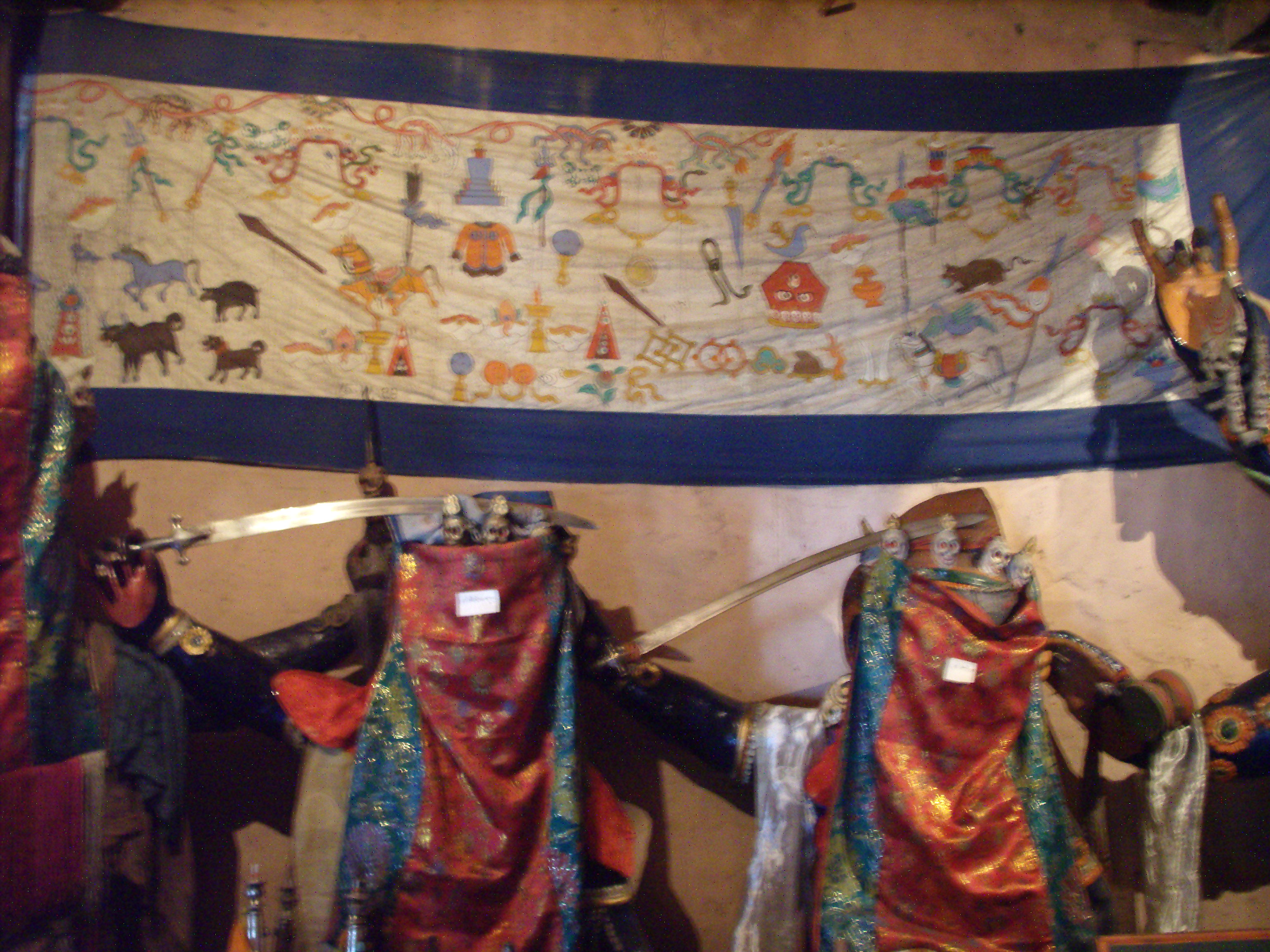
The older buildings of the monastery (some monasteries claimed to go back more than a thousand years) were higher on the mountain side.  Therefore we climbed numerous steps, which is quite normal for gompas we visited.  There was a protector shrine with its residents having their wrathful faces covered by cloth, a meditation hall, and a spot where the lamas performed wrathful / purifying pujas.

Actually, our guide told us a very curious story about this protector shrine – in collaboration with what looked to be a human skull in the hands of one of the deities.  This is from my memory, so forgive me for the errors which I know are present, but a long time ago, there was a prince.  He made a pact with the local Dharma protector – “help me defeat my enemies in battle and I will dedicate my life to you.”  Sure enough, he was successful in battle.  He wanted to go about his life normally, as a prince might, afterward, but for some reason he could never leave the monastery.  When he tried, strong winds or weather would prevent him from doing so.  Therefore he stayed at the monastery for years.  Finally, he became so tired of being chained as it were to the Dharma protector, that he decided to end his life than go on with his present existence.  He jumped to his death – a long plummet off the highest monastery wall.  His body fell a long way down into a ravine, which was very dangerous for the monks or local villagers to try to get to.  Therefore, I believe the animals and vultures cleaned the bones.  But somehow, mysteriously and ominously, the prince’s skull came to be found in the hands of the Dharma protector in the monastery – where it has been to this day.  (most of this story is accurate from what I heard)  The moral of this story – be very careful with the vows you make (and break)!

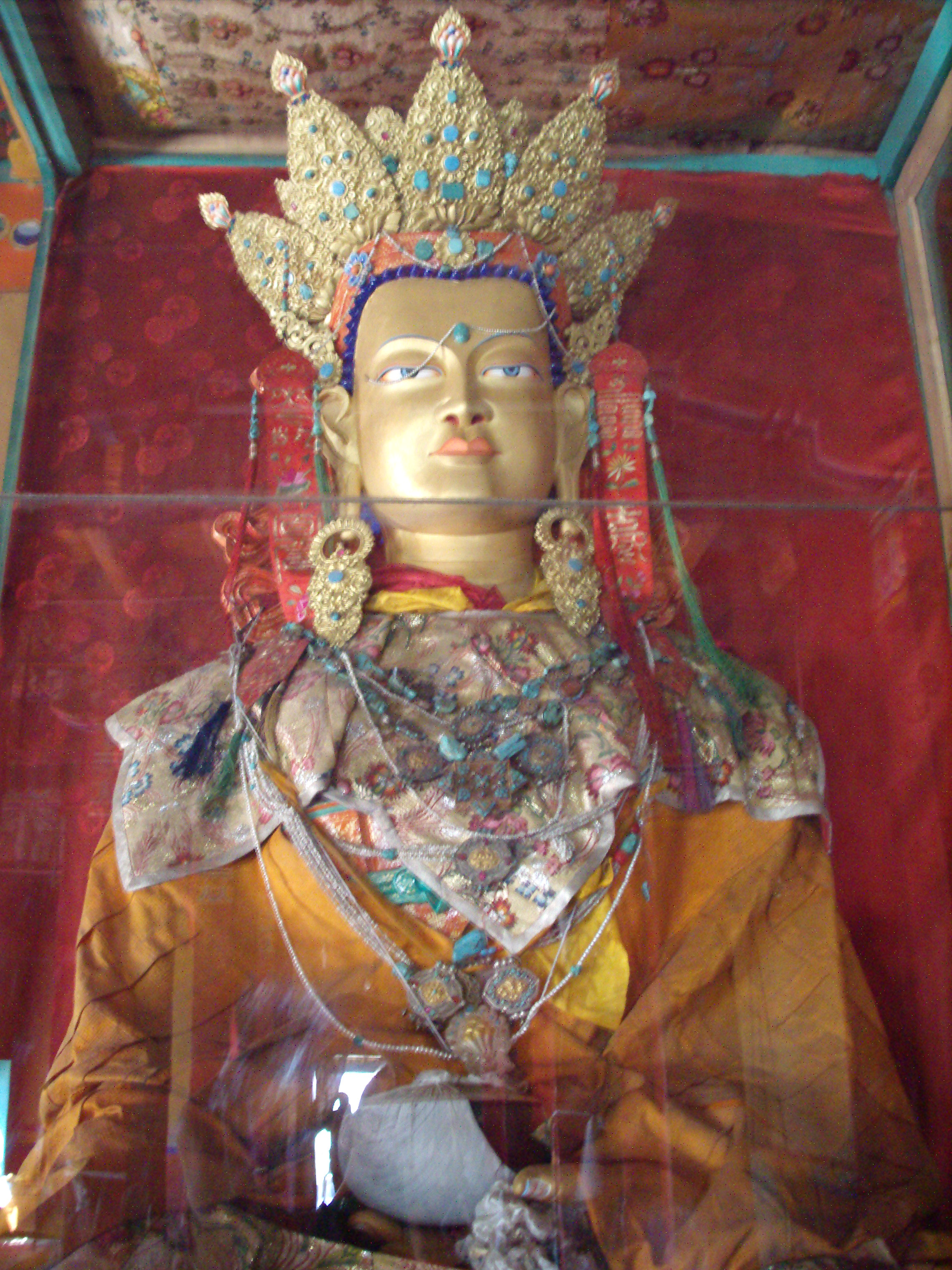
This outdoor Buddha was a preview for a gorgeous statue we would visit later in the pilgrimage at Likir Monastery (in a future post).  And I am sure by now that this Buddha statue has been completed and it is radiantly sitting on its perch, gazing out over and protecting the Nubra Valley.

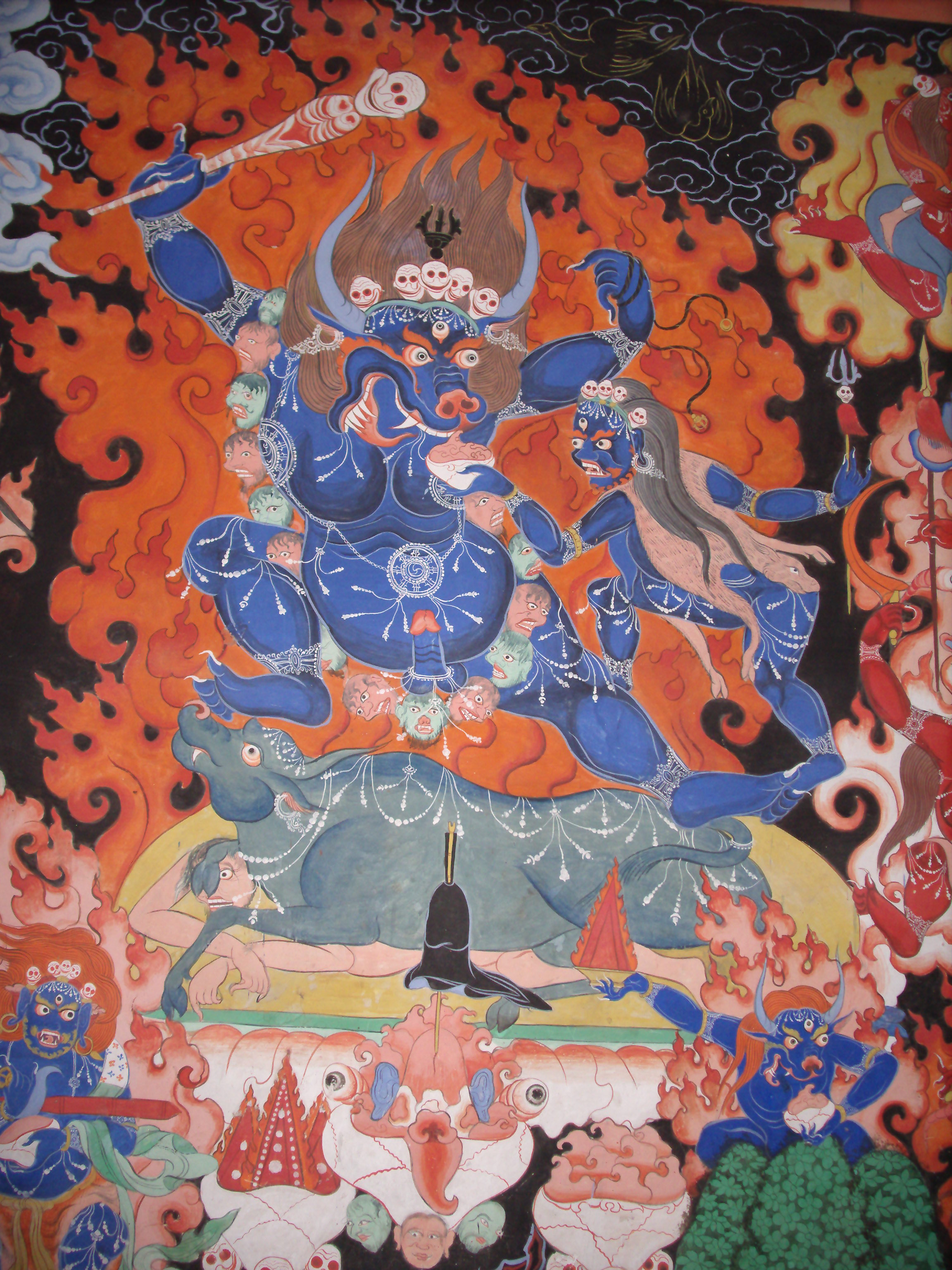
At the top of the monastery, there was a curious stone slab, square in shape, with two little partitions as it were.  The partitions had seed syllables of wrathful deities on them, and so I asked what this was.  The lama who was with us told the guide, who translated it into English.  This was where wrathful / purifying pujas happened – the seed syllables on the partitions protected the lamas from the nasty stuff – it sounded like they performed potent rituals here – possibly along the lines of exorcisms.

I have many decent pictures from this monastery, but I have tried to present several here that are representative of the batch.  It is with tentative apprehension that I post this photo of the Dharma guardian with the skull in its hand – please treat it with respect.  And have a good day.

Thank you for visiting!

Kirby Moore

konchog chakchen

Ladakh Pilgrimage – Life in the Nubra Valley

This material is copyrighted by Kirby Moore.  Reproduction without permission is prohibited.  To support my business and blogging efforts, please visit my website. More recently, I have begun teaching Astrology classes on Trauma-Informed Astrology, see http://www.traumainformedastrology.com for more! Thank you for visiting!

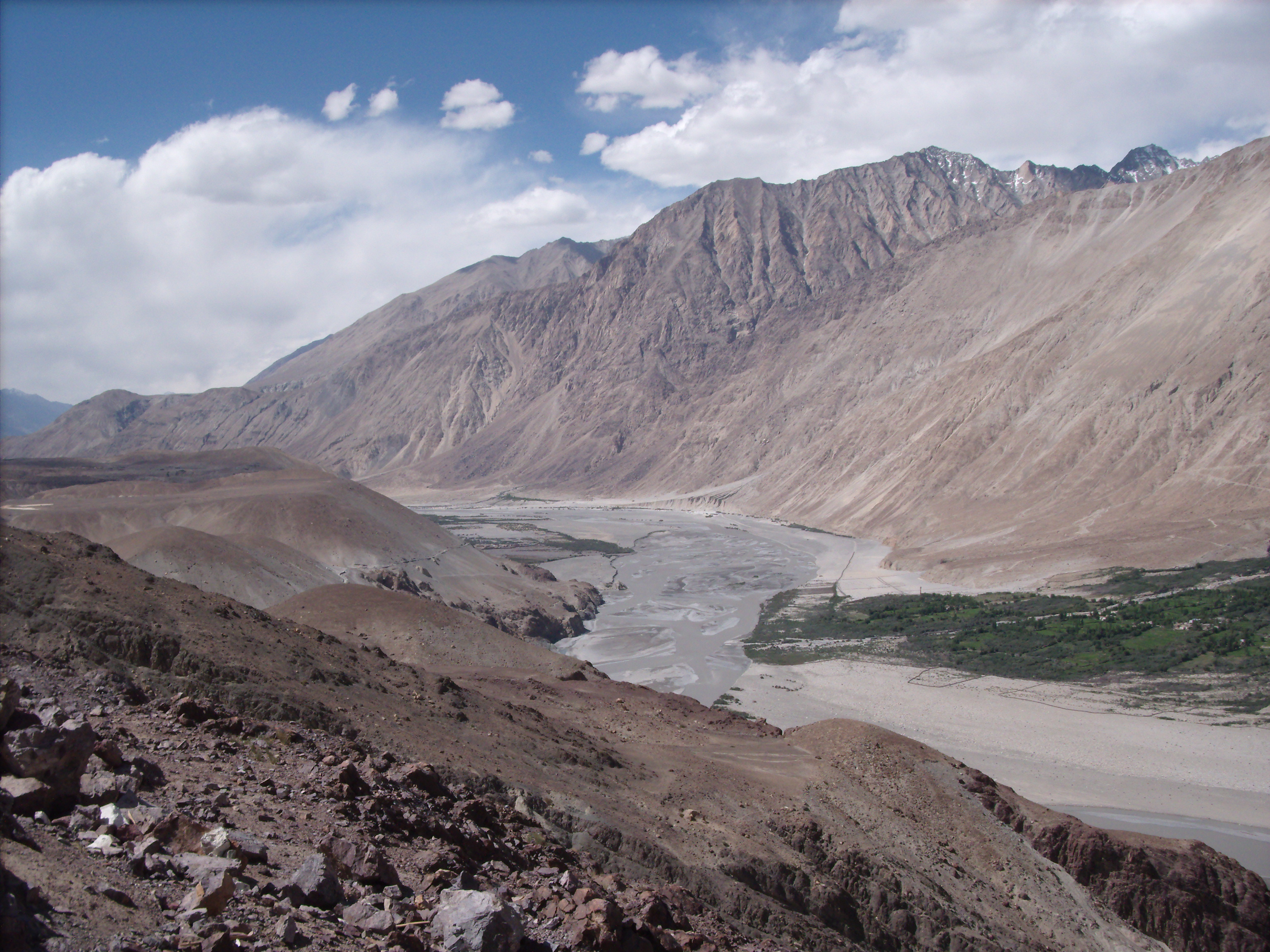
I originally wrote that going to Ladakh was going to a new world, which is true, but going to the Nubra Valley was yet another new world.  It was just as dry as the world we left behind, but it had towering sand dunes, striated canyons, (similar) treacherous roads and in one of its villages, a slightly Persian feel to the people.  There is greenery next to the river and the rivulets, sharp steep pinnacles and rocks are everywhere.

I wrote in my journal: “it looks like Utah plus Egypt plus Afganistan with the Moon and Mars thrown in for good measure. Bily Brown on the banjo, making the strings of my heart twang, brushing my teeth with willow, watching shooting stars and having a good laugh with members of the pilgrimage.”  There are an abundance of apricot trees (one of the only fruits to enjoys growing at altitude – hence the sugary staple of Ladakh – juices, jam, dried fruit and seeds all come from this hardy tree). 

6/24/08 – another full day.  We visited Sartok (sp?) monastery, crossing the river to do so.  There are many statues and paintings, plus some black backgrounds with gold painted on it – making for a difficult-to-discern-yet-eerily-beautiful murals.  As we were leaving, we passed a monk carrying a boy on his shoulders.  The boy had on gold and saffron colored clothes, and some people were wondering if the child were special in some way – normally monks aren’t walking around with small children like that.

We stopped and sure enough, it was Bakula Rinpoche – the famous monk (tulku) whose previous incarnation was India’s ambassador to Mongolia.  He is a Gelugpa Tulku and he was just four years old when we saw him.  He was precious – he was playing with a toy, while many villagers and ourselves requested blessings of him.  The monk – I’m assuming his tutor – would say, “khata, khata” and point to us as we were waiting for his blessing.  He would pause his playing with the toy and put the khata around our necks and then go back to the toy.  There was something piercing and radiant about his eyes though – part child, part meditation master?  What a precious opportunity.

We came back for lunch, to the camp site.  A couple days earlier, I had put in a request for meat, because I normally have several servings of meat per week and we had been on a completely vegetarian diet up to that point.  However, they took the request quite literally and began to offer us meat with every meal…  Whoa!  Luckily I was not the only one who needed it.

Later in the day, we rode Bactrian (sp?) camels – two humps.  There seemed to be a group of men who took care of the camels, and a group of Asian tourists got off and a couple minutes later, we got on.  Of course I was given the camel which seemed to be the most ornery.  Luckily it didn’t spit on me.  Although it required a guide all to itself as it kept trying to carry me off in another direction.

Some of the group went off to see a local deity shrine.  Apparently it was a bit of a hike, and I was tired from the day, so myself and a few others stayed behind.  In retrospect, considering how precious and rare the opportunity was to be in this marvelous and new country, I would have rather attended every event possible.  As it was though, I only missed a couple things.

As I mentioned in an earlier post, the Ladakhis are incredibly efficient with their water usage.  Their systems of irrigation are precise and “turned on and off” at various times during the day.  I say this because this particular canal near our campsite was full of water in the mornings but always running dry by early afternoon and evening.

Thanks for reading!

Kirby Moore

konchog chakchen

Pilgrimage to Ladakh – Kardung la Pass

This material is copyrighted by Kirby Moore.  Reproduction without permission is prohibited.  To support my business and blogging efforts, please visit my website. More recently, I have begun teaching Astrology classes on Trauma-Informed Astrology, see http://www.traumainformedastrology.com for more! Thank you for visiting!

6/23/08 – Yesterday was a good day.  We saw incredible monasteries, a veritable Buddist city on a hill and we crashed a Ladakhi wedding where everyone was incredibly generous and welcomed us with warmth and authenticity.  Well guess what I discovered on this day, which might live in infamy in my viscera…  My fear of heights translates to many different situations – Yay!  Or I should say, Ouch.  Here’s why:  The roads in Northern India are not any better than the poorest roads in the United States (from my limited travels).  I guess we should be grateful that they have roads at those high altitudes in India at all, but…  I’m not sure I need to be on them!  Maybe if I practice more Dharma I will let go of my attachment to self and this little phobia will go away upon doing so.

We were heading to the Nubra Valley.  There are several monasteries in this valley, along with views of a canyon which rival that of the Grand Canyon in Arizona, USA, and there were several little surprising attractions as well.

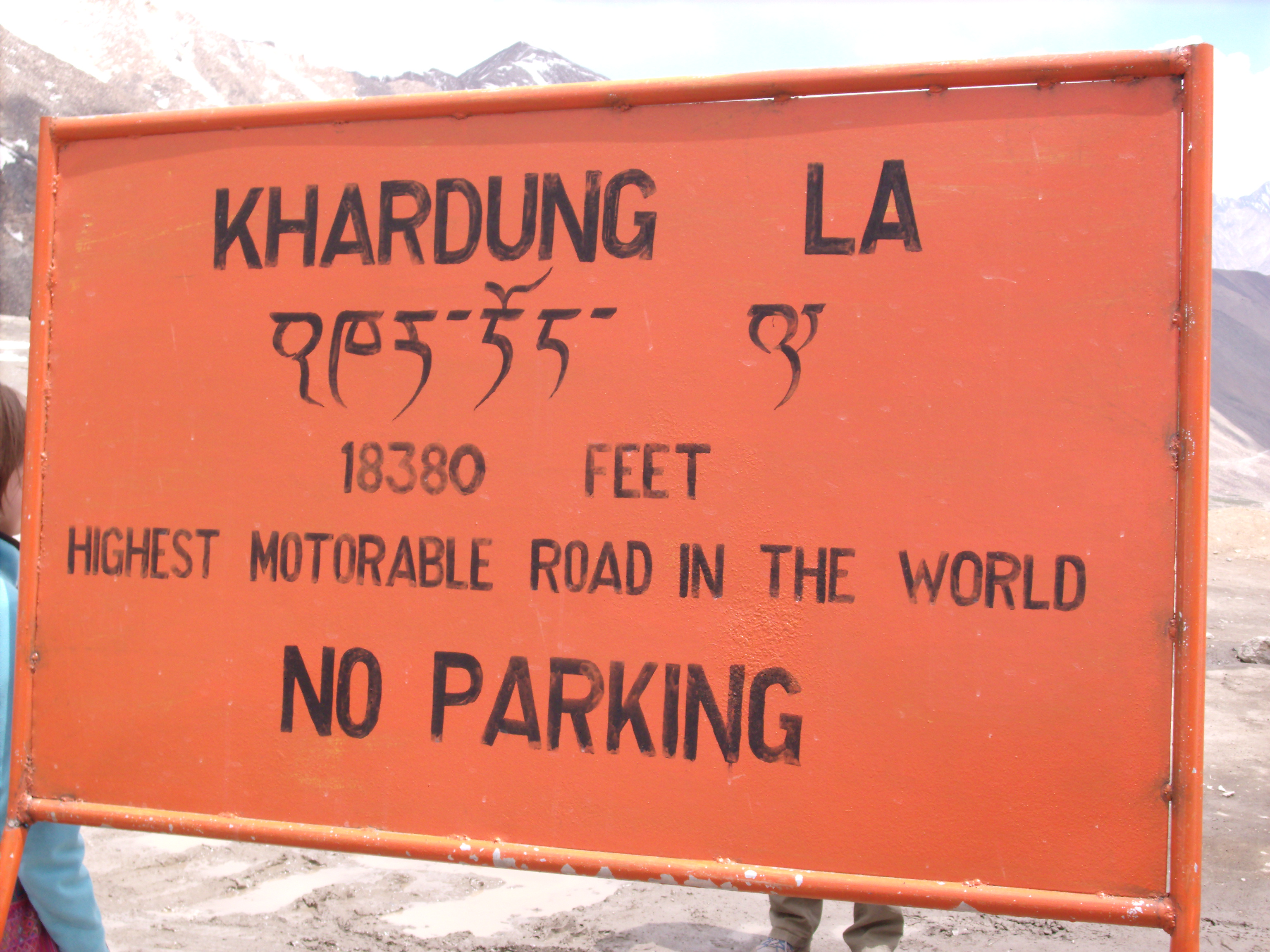
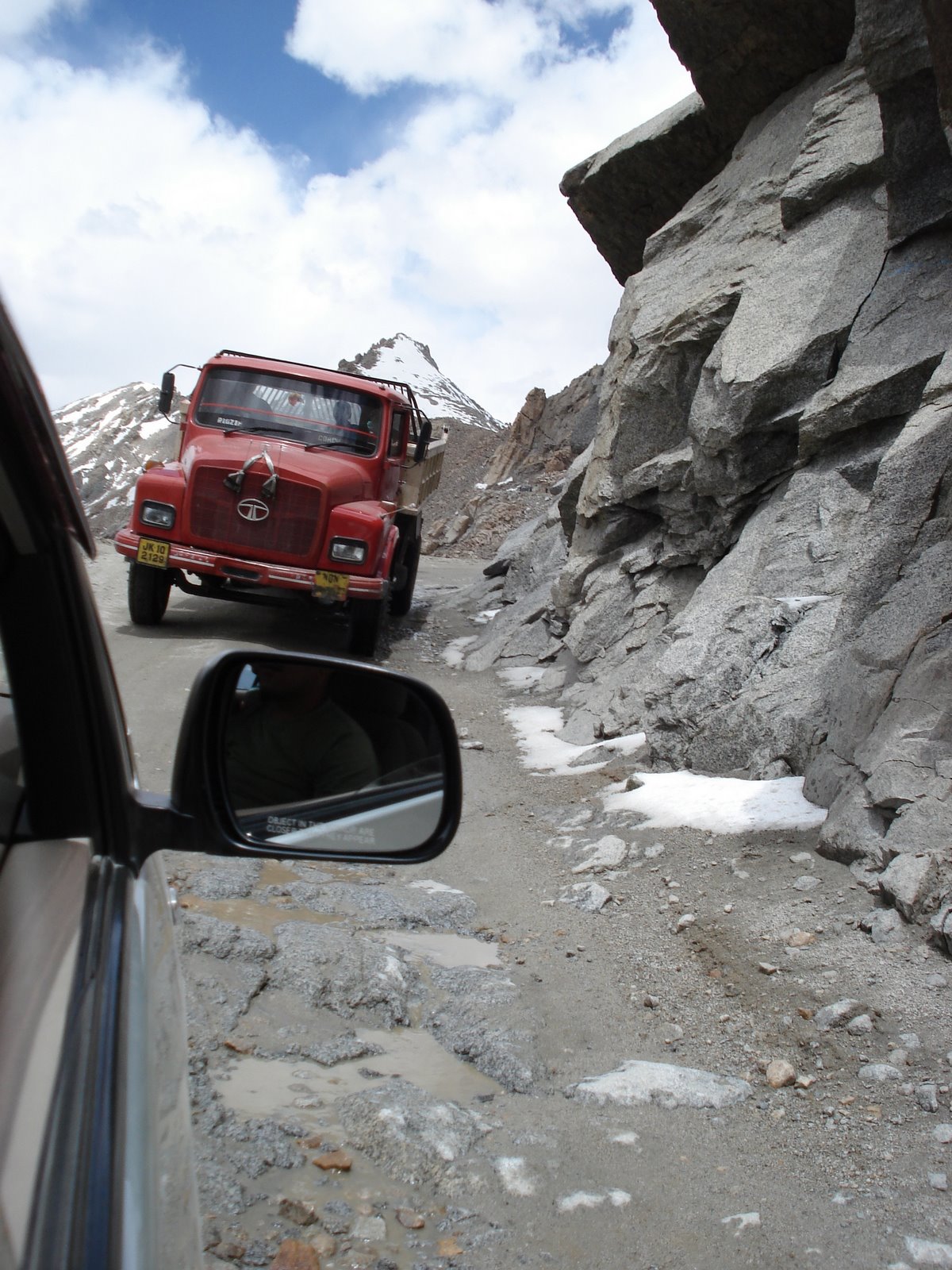
On this day, we primarily traveled by car, up and across the highest motor-able road in the world.  Seriously – 18000 plus feet.  The problem, if I may go so far to call it that, was that to get to the Kardung la Pass, most of the road hugged the sides of precariously steep, cliff-like mountains, some of which seemed to be supported by shoddy masonry (only).  As we went up higher and higher, we would see, far down the slopes, skeletons of Jeeps and LandRovers and buses that had fallen off the road, most likely with tragic consequences.  And as if that were not enough, there were a couple places where rock slides had taken the road out and they were in the process of patching it back together.

Oh, and I need to mention that we were heading into areas that border Pakistan (or China), and therefore we had to have our passports with us in case we came to a military check point, which was not uncommon.  That also meant we had to be careful what we photographed (basically no cameras around military installations).  Not to cast a somber mood, because it seemed like these rules had been relaxed, but all of this was in my mind as we climbed to the highest point in our pilgrimage.

Just to give readers a little glimpse of what I found frightening: nearly all the corners around the mountain roads are blind.  There are no lines on the road, no median and no extra space in the shoulder.  Also, on at least half of the curves, there were no guard rails.  So a slight mistake on the driver’s part or by the on-coming driver, and well, it would be time to practice Phowa (and hope our preparations for our next rebirth had bee in good order).  Therefore, the drivers constantly honked as they approached each curve (thank goodness!) and as a result, I was constantly reminded of my fear of heights…  But there was a silver lining and a beautiful valley to see on the other side.  With that…

In my journal, I mention that there were large, colorful cargo trucks on this road, along with other buses and vans full of people and supplies.  From about 16000 ft and up, the pavement stopped and more of a patchwork of cobblestones could be observed in the road.  This was true on both sides of the pass.  All in all, the journey to the Nubra valley took six hours (from Leh).

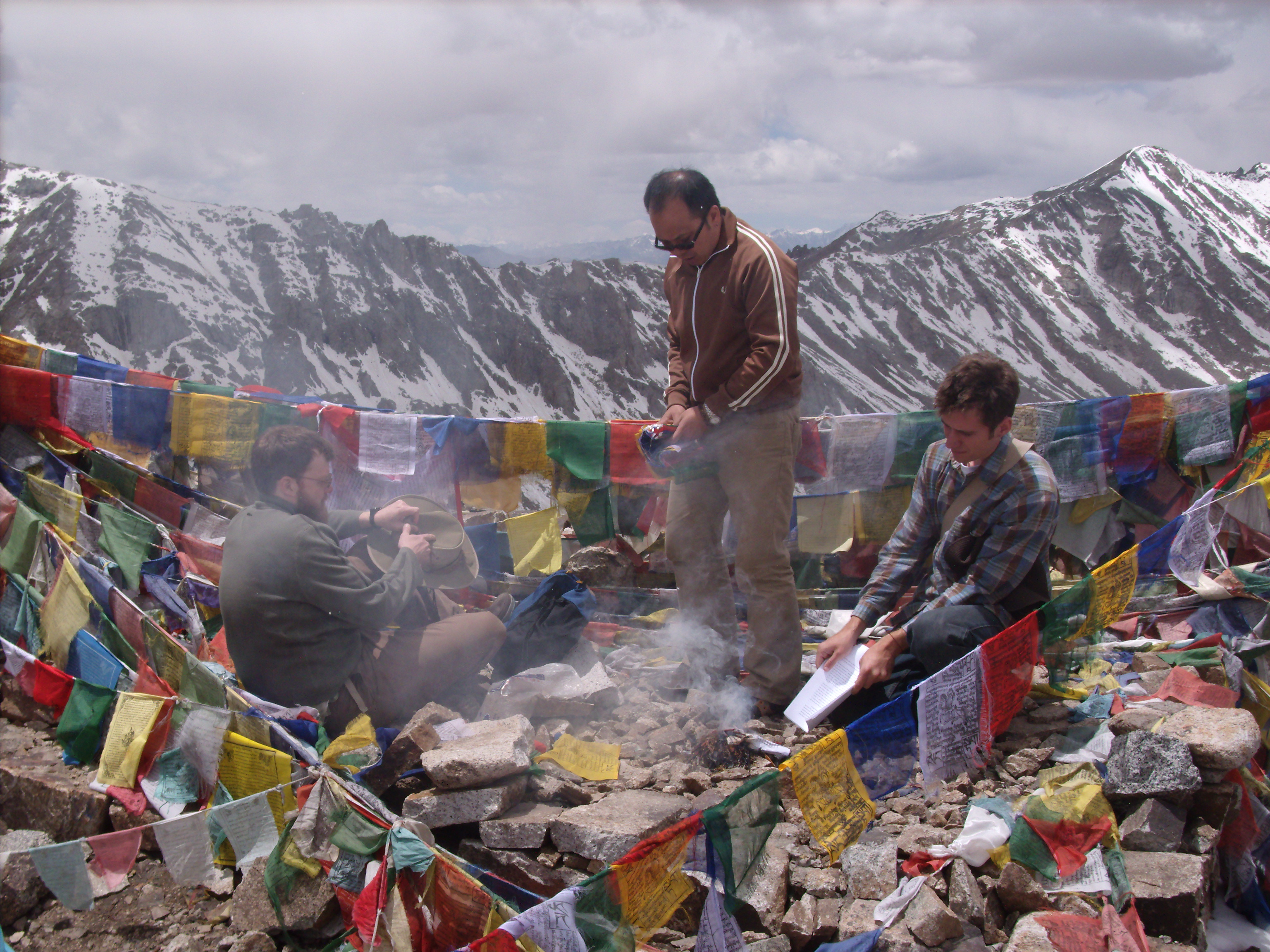
On top of Kardung la Pass, the air was thin, clean and crisp.  Considering we had gone from Leh at 11000 ft to 18 K plus at the top, we needed jackets and there were little stubborn patches of snow around.  Oh – a side note.  Thankfully we did smoke pujas – otherwise known as offering rituals of protection on most days of the pilgrimage.  And on this particular day, I was enormously glad we had done these rituals and that we continued doing them.  We did smoke offerings at the top of the mountain as well, at least most of us did.  Some people (those of us with spry youthful bodies) decided that 18,300 ft was not high enough and that they should continue climbing a rocky ridge up toward some boulders (see photo).

There was a military outpost on the pass, with soldiers milling around.  There were a number of other tourists as well.  We went up a little ways and came to a curious little temple – a one roomed shrine.  There was a small couch or bed of sorts which made me wonder about its occupant.  The shrine was in good order.  While this little temple was fascinating, what really took the cake for me was the prayer flags on the “summit” near the pass.  I got some good photos of members of our group, of the smoke offering being made and of the surrounding mountains as well.  They said that, on a perfectly clear day, which was not this one, people could see all the way to the north and gaze upon K-2 – the second highest mountain in the world.  As it was, they pointed out several mountains which were near K-2 (I guess its brothers and sisters).

We stopped for lunch near the side of the road, in a village that had an army base in it.  There were wild dree (sp?), the hybrid breed of yak and cows, running around.  They were incredibly dexterous and agile – considering they may have weighed in excess of 300 lbs!  It was fun to observe a new species – a really hairy, agile cow.  At first, some of us thought they were yak but we were quickly corrected.

Once we got to Nubra, there was a separate truck that had our supplies and workers (cooks and camp setter-uppers) – they had gone on, just ahead of us.  We put our stuff in our tents, were supplied with sleeping bags and pads and some of us, like yours truly, were so exhausted from the long, precipitous ride that we took a nap.

Up above you can see the glacier which provides the water for Leh and its valley.  They said that each year it is slow shrinking, which is going to be a problem one day.  The Ladakhis are some of the best in the world at channeling water – their systems of irrigation were just mind boggling.  But without any water to transport…  Yes, a problem indeed.

Thank you for reading!

Kirby Moore

konchog chakchen

Crashing a Ladakhi Wedding

This material is copyrighted by Kirby Moore.  Reproduction without permission is prohibited.  To support my business and blogging efforts, please visit my website. More recently, I have begun teaching Astrology classes on Trauma-Informed Astrology, see http://www.traumainformedastrology.com for more! Thank you for visiting!

I went with a great group of students and practitioners and wanderers to Ladakh India in June and July of 2008.  We had some incredibly amazing experiences – just coming back home, safely, after riding around the Ladakhi roads is saying something.  But one of the surprising events, not on our itinerary, was on June 22nd.  We were coming back from Chemray Monastery, when, luckily the trip guide had the windows down in his car.  He heard some music coming from far off and asked the driver to stop.  They backed up and sure enough, there was a wedding going on, out of sight but relatively close to the road.  And of course you bring your 16 Caucasian, Western (clueless) tourist / pilgrims to a random wedding!  I mean who doesn’t?

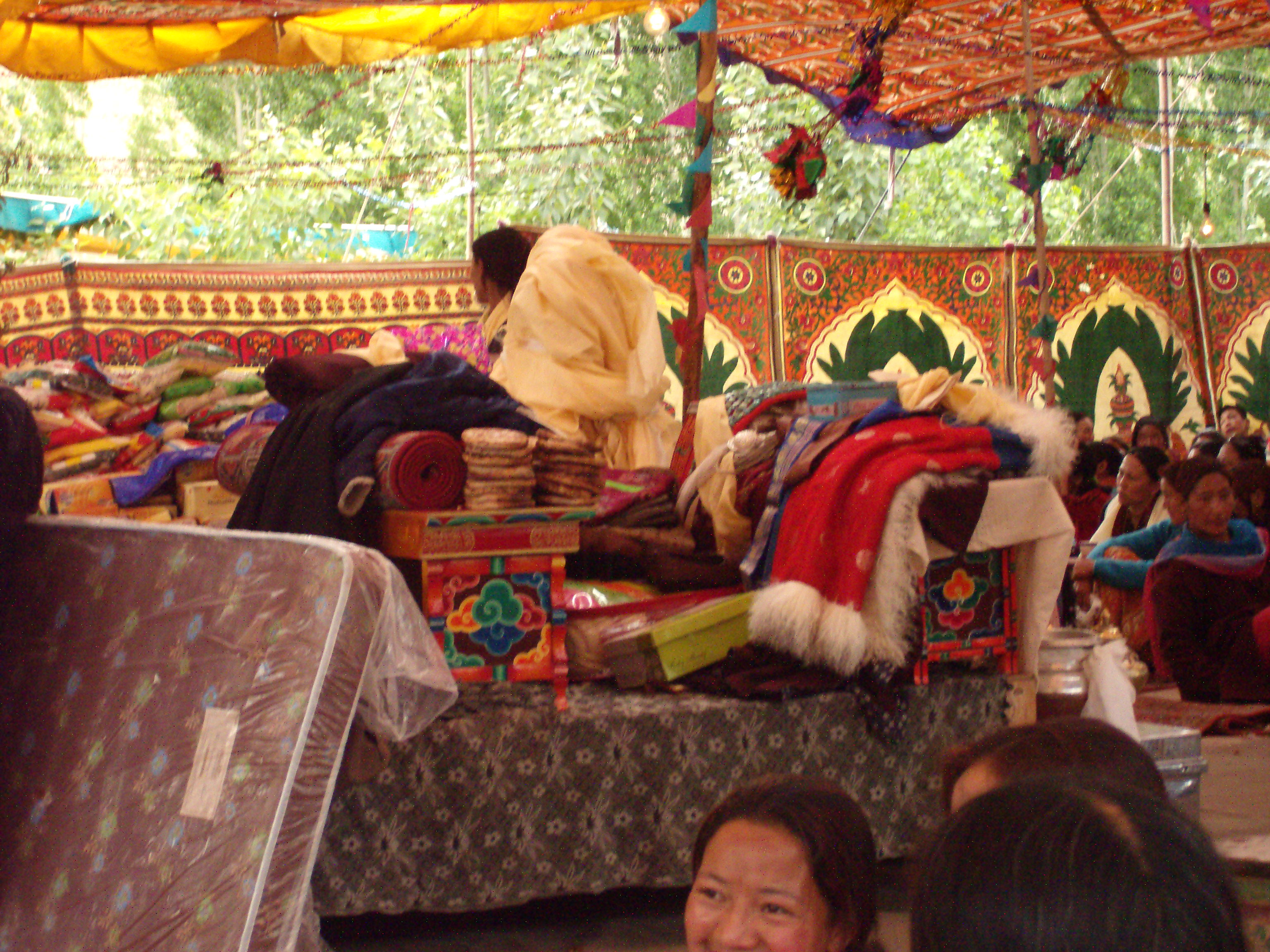
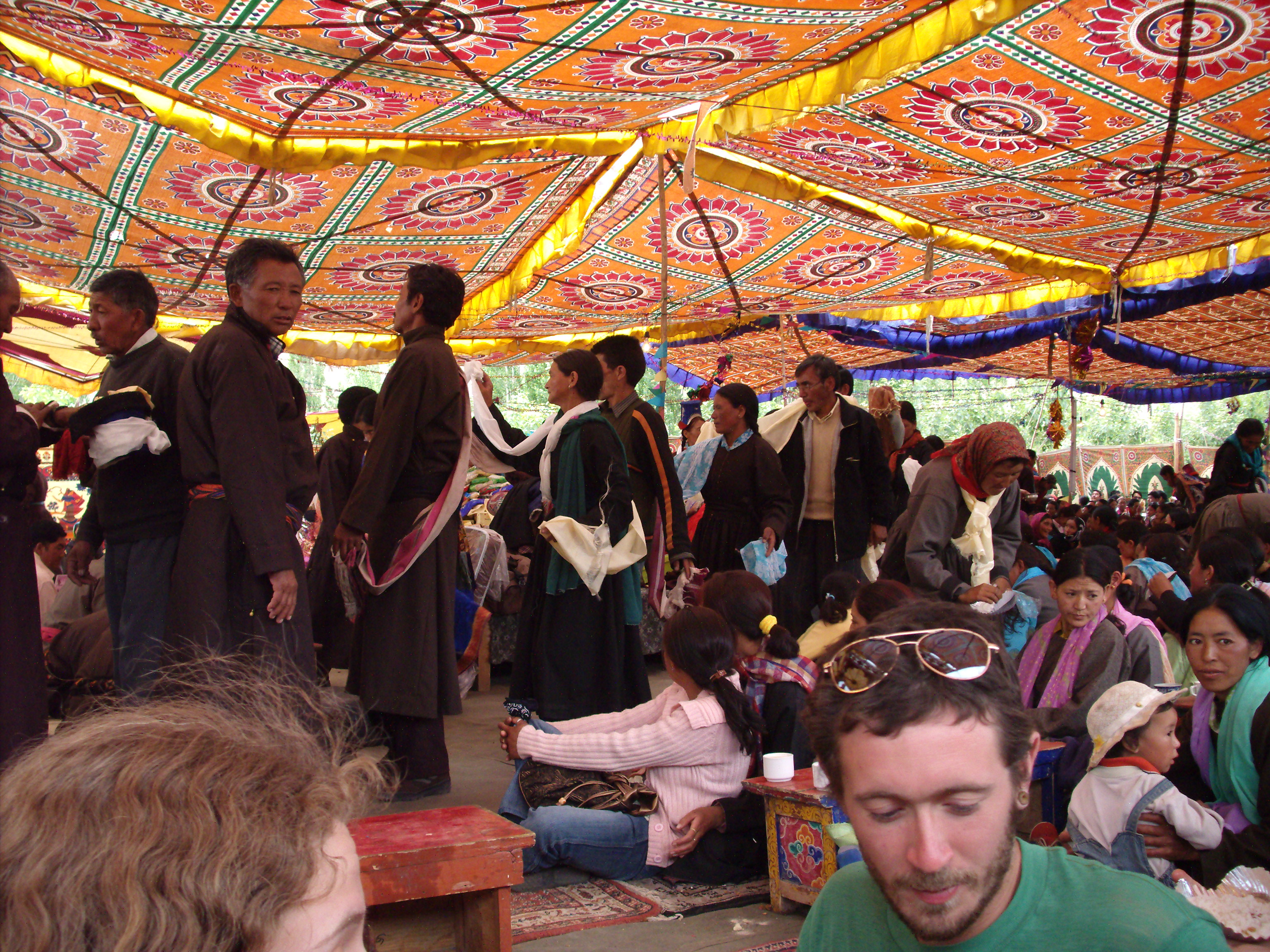
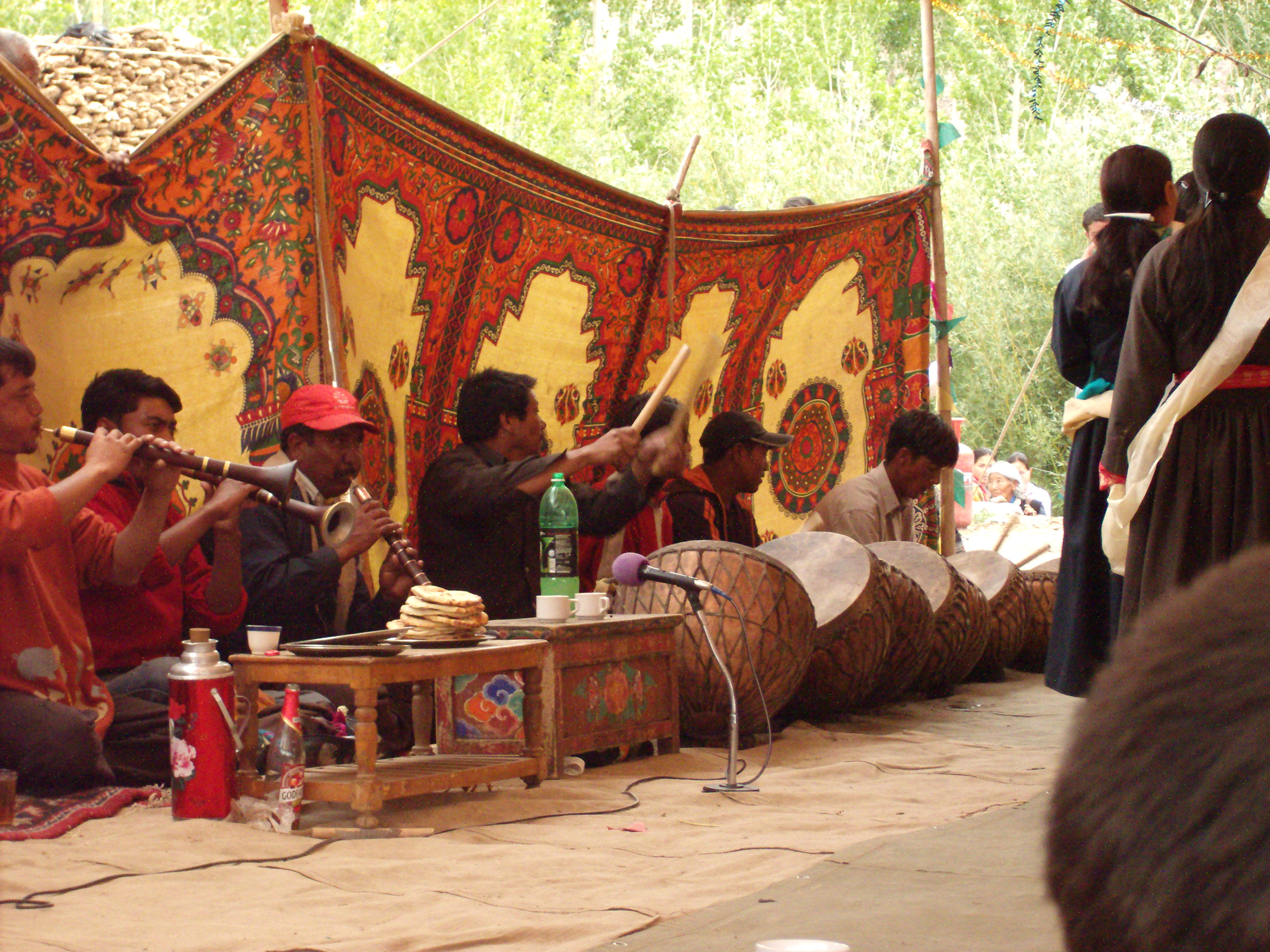
In the first picture, is the significant pile of wedding gifts, which I will get into.  But first, we were a little hesitant.  Was it okay to crash a stranger’s wedding?  Did Namgyal, the guide, know these people?  No he was not sure but he was insistent anyway.  It turns out he knew some relatives of the bride and other friends.  There was an enormous tent set up, with tapestries (dyed cloth) serving as the roof.  And under this tent, there were at least 200 people – seriously.  Up front where we came in, there were five or six musicians, playing big drums, little drums and a couple had wind instruments – horns of sorts.  Every once in a while, the drummer with the largest drums would shlop some oil on his drum and smooth it around before continuing to play.

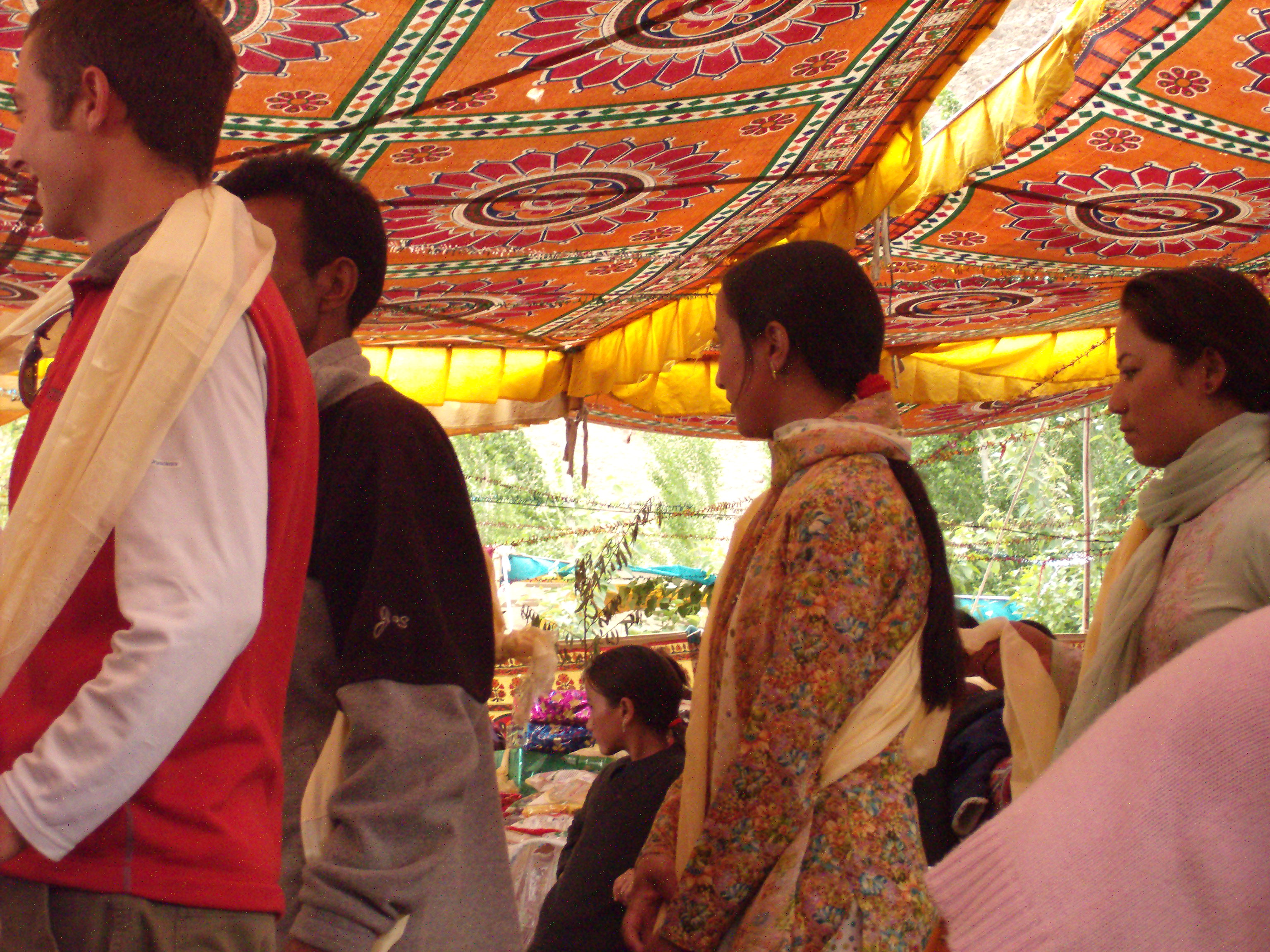
The Ladakhis were so, so sweet and generous.  They made room for us up front and then they proceeded to treat us like we were honored guests – have you ever heard of such a thing?  The parents of the bride and groom came by and greeted us – shaking our hands.  Then they passed around plates and cups, along with the traditional Tibetan / Ladakhi butter tea – a very salty, buttery tea.  Normally that tea is not my favorite, but on this day, it was awesome – of course it is like a meal in a cup, but it is filling and warming.  Quite nice at the right time.  Then someone came around with the celebratory rice with small sweet-potato-like roots in it, sweetened with raisins.  I think it is called trol-ma-drey-see in funky phoneticized Tibetan.  And that’s not all!  After they had given us something to drink and fed us, someone passed us some Ladakhi Chang – it was called “Godfather.”  Chang is the fermented barley beer / wine.  Little did I know, and thankfully it was not a problem, but in Ladakh, this is not pasteurized – so the probiotics and vitamin B’s are better but you better hope they used clean water!

We arrived as they were about to start dancing.  In Ladakh, they do a rhythmic, slow circular dance which I believe resembles and signifies a flower blossoming.  The matron of our guest house explained it later on in the week.  Some of us got up and danced with them, some people had to be pulled.  For some reason, I was enjoying the Godfather (beer) too much to dance – or I had not had enough yet!  On a side note, I have given up drinking for the most part, except on Tibetan holidays or with religious celebrations and on this day, I made an exception.  Hey – when it Ladakh, do as the Ladakhis do – right?  The tent was so large that, despite 30 or 40 people dancing in a circle, there were still rows of people in the back and they only circled a small part of the space (where the gifts were situated).

Later, once the dancing paused, the groom and his friends got up in front and started talking amongst themselves and occasionally one of them would go and talk with the parents of the bride / groom (I could not tell who was with whom).  If this wedding was anything like a traditional Tibetan wedding, which I only know a little bit about, the families involved probably planned the union.  We were there for at least an hour – maybe two – and we did not see any vows being exchanged and only rarely was the groom anywhere near the bride.

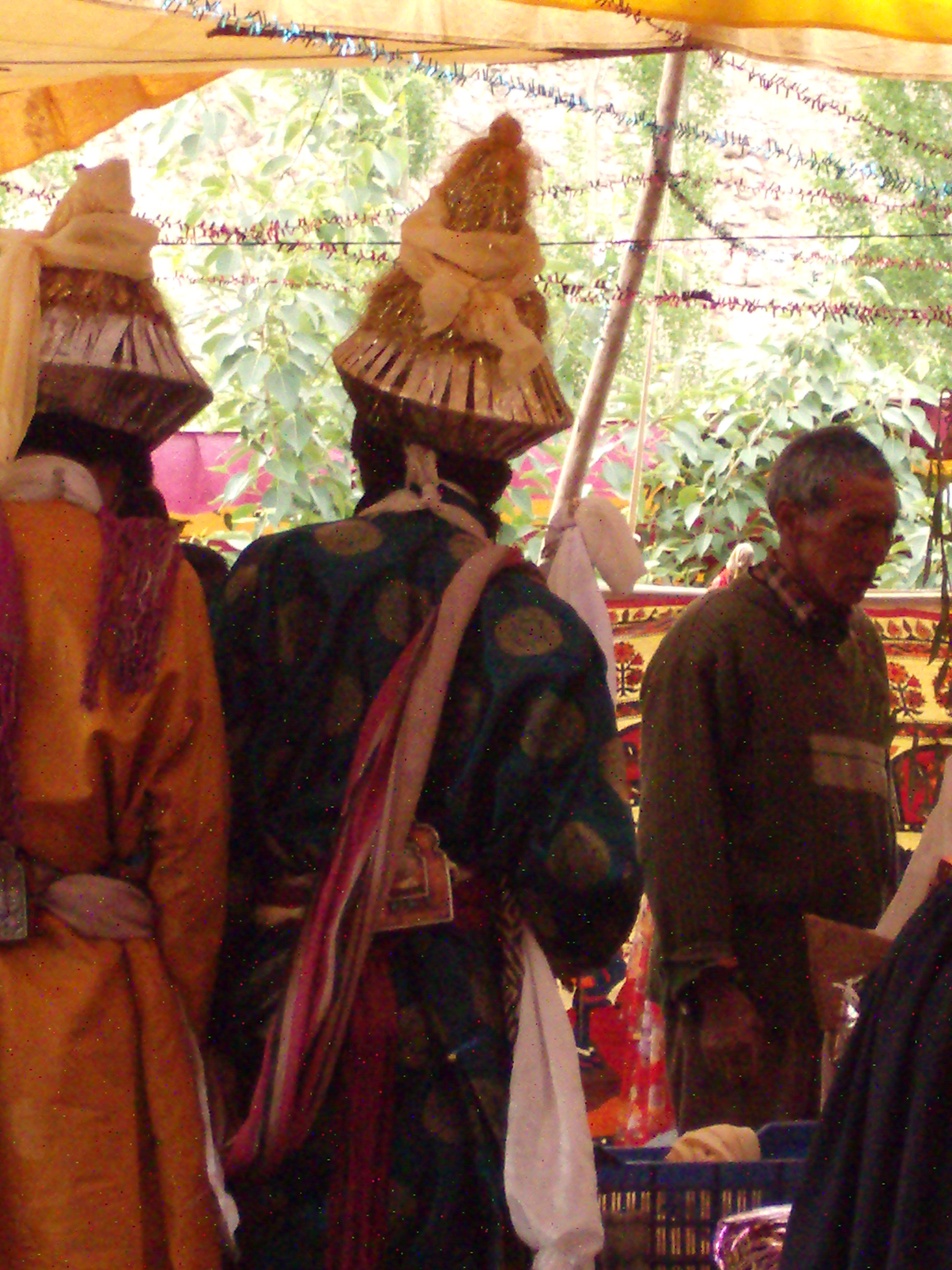
The groom and his friends were wearing some very interesting clothing and accessories.  The groom had a traditional Ladakhi / Tibetan / Chinese tunic, blue jeans, Nike running shoes and he and his friends (about half a dozen or more) were wearing hats that looked like they were trying to communicate with extra terrestrials.  I’m not sure if this is traditional garb for Ladakh, but see for yourself.

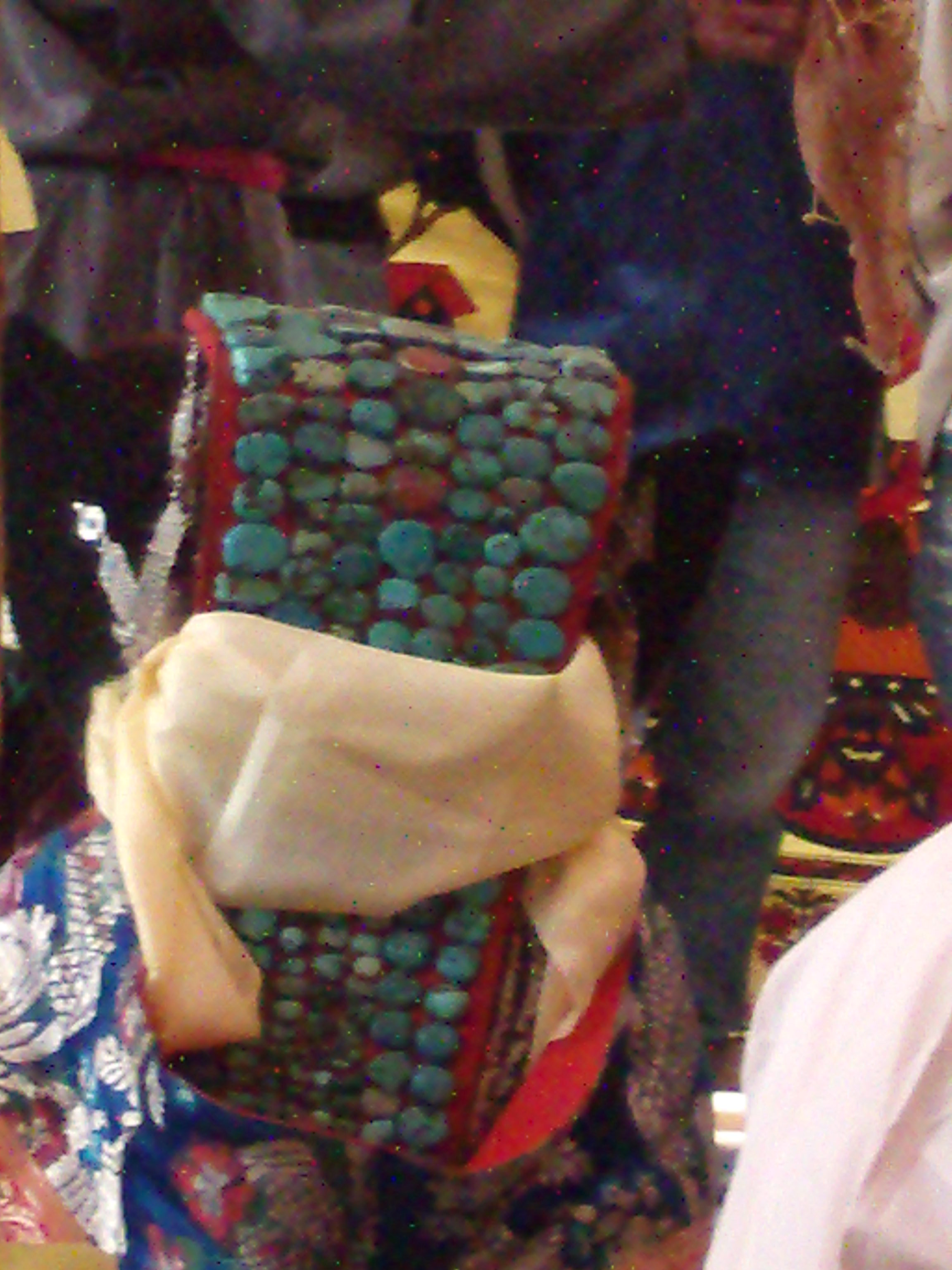
The bride was wearing the traditional turquoise and semi-precious stone head dress herself.  I have heard that these are very heavy, and since I mainly saw the bride sitting down, it made sense.  The ceremonial female headdress is like a cobra’s hood of sorts and actually the money in the Ladakhi families is controlled by the women because it is in their jewelry.  Patriarchal religion but matriarchal family structure of sorts.  See below for a picture of the back of the bride’s head – she was turned away from us and I did not feel like running around being a photographer (might have been rude at an otherwise awkward situation to begin with).

Thanks for reading and have a good day.

Pilgrimage to Ladakh – Chemray Monastery

This material is copyrighted by Kirby Moore.  Reproduction without permission is prohibited.  To support my business and blogging efforts, please visit my website. More recently, I have begun teaching Astrology classes on Trauma-Informed Astrology, see http://www.traumainformedastrology.com for more! Thank you for visiting!

As I reflect on my trip to Ladakh, we were so very lucky.  We had numerous adventures which tourists can only dream about – attending a Buddha and a King in His Holiness Chetsang Rinpoche, crashing a traditional Ladakhi wedding, attending a shaman / oracle and seeing her in action, as well as having tea with numerous Tulkus (recognized reincarnated Lamas).  It might be difficult to replicate this pilgrimage in this lifetime.  And of course there was the camel riding and other “touristy treats.”  Wow!  Needless to say, I’m glad I went.

So, in this post, there is a little Buddhist city known as Chemray Gompa.  As we drove by it on the way to Tak Thog monastery further up the valley, I had an inkling I had been there before.  It literally looks like a town on top of its hill – all the building in the traditional colors of monasteries – hence the Buddhist City designation.  It is (another) Drukpa Kagyu monastery – as the majority of the monasteries we visited were of that sect.  But it’s splendor is not easily passed over.

We ate lunch below the monastery and we got to see several Ladakhi families – including precious toddlers running around, exploring the stream and the irrigation canals.  Afterward, we drove up the winding road to the monastery.

There were some local villagers at the monastery when we arrived, and seeing an ancient looking Ladakhi, her eyes deep and present, full of wisdom and chanting the Mani Mantra was precious.  She may have been in her 50s or 60s, as, due to malnutrition and the harsh environment, Ladakhis tend to age quickly.  In the states, her appearance might indicate 80 to 90 winters.

There were gorgeous murals (including these impermanence-inspiring dancing skeletons), very fresh and crisp – as if they had just been painted the day before.  And at the very top of the monastery was the Guru Lhakang – the Guru Rinpoche shrine, and the paintings in there continued up the 20 ft walls and then across the ceilings.  Incredible!  This is where we saw the “I <heart> Drukpa” bumpersticker with His Holiness the Drukpa Kyabgon’s picture.

Thank you for visiting!

Kirby Moore

konchog chakchen

Pilgrimage to Ladakh – Tak Thog Monastery

This material is copyrighted by Kirby Moore.  Reproduction without permission is prohibited.  To support my business and blogging efforts, please visit my website. More recently, I have begun teaching Astrology classes on Trauma-Informed Astrology, see http://www.traumainformedastrology.com for more! Thank you for visiting!

In this post – we went to two monasteries on this day, along with crashing a Ladakhi wedding – what a surprise treat!  The second monastery and wedding will wait for the next post.  So, we went to two additional monasteries today – and while yesterday had the enormous Buddha statues, this day and its monasteries had their own selling points.  First we drove to Tak Thog (rock ceiling) monastery and then visited Chemray on the way back.

We were in the car at least 90 minutes to drive out to the far reaches of Ladakh, in fact, Tak Thog monastery is significantly higher in altitude than Leh, I would guess it is at least at 15000 ft.  We noticed the difference when we were climbing the monastery’s many steps.  The road basically ends at the monastery because beyond, the mountains become too steep.  In my journal I wrote that it was “way out in the middle of no where” which is saying a lot for ultra-rural Ladakh.  Tak Thog is named appropriately, because some of its shrine rooms are in cozy, butter-lamp-soot stained caves with low rock ceilings (the rock walls and ceiling are black from the butter lamp exhaust).  It is famous for having hosted Guru Rinpoche (he meditated there) and he apparently left a foot print in his meditation cave – however, today there is always a retreatant in that particular cave and we were not allowed to see it.  Does that sound at all fishy to you?  Not that it didn’t happen of course!

In this particular photo, I could not get a completely clear picture of this shrine room, even though I took over a dozen shots (?).  However, this is the best pic I have.  The ceiling had paper money (rupees) and coins stuck to it as offerings.  Notice the black color of the rock.

The guide said that the monastery was “one ridge away from a glacier” (which is where the water for the long valley below originates).  There were big round rocks all over this monastery, which was a treat.  Unfortunately, the murals and paintings were blackened with soot and could only be viewed as vague outlines.  This is one of the only Nyingma (ancient school) monasteries in Ladakh, so there were multiple statues of Guru Rinpoche.  They were in the process of filling several – so a monk gave us a detailed explanation of that process (filling a 2 meter statue would take at least two months – so a tedious task to be sure).

I loved how this monastery used the natural rock formations, it was almost as if the mountain and the rock were more important than the building itself.  What a great indigenous / Earth-loving concept!

Thanks for reading!

Kirby Moore

konchog chakchen

Pilgrimage to Ladakh – 6/21/08 – tidying up

This material is copyrighted by Kirby Moore.  Reproduction without permission is prohibited.  To support my business and blogging efforts, please visit my website. More recently, I have begun teaching Astrology classes on Trauma-Informed Astrology, see http://www.traumainformedastrology.com for more! Thank you for visiting!

In this post – a little continuation from 6/21/08.  This is a picture of Buddhas carved in the 10th century!

I forgot one thing from the previous day, which is pretty cool.  After Shey Palace we visited these carved rocks.  Apparently these carvings are from the 10th century – which means they are over a thousand years old!  Wow.  They look similar to saints of other traditions.

Continuing my Pilgrimage to Ladakh series, a bit delayed

This material is copyrighted by Kirby Moore.  Reproduction without permission is prohibited.  To support my business and blogging efforts, please visit my website. More recently, I have begun teaching Astrology classes on Trauma-Informed Astrology, see http://www.traumainformedastrology.com for more! Thank you for visiting!

In the title I mention “a bit delayed.”  Perhaps it has taken this long for me to have quality down time and who knows, maybe I am complete in my processing of the Pilgrimage – but I doubt it (two years later).  In the post where I left off, we had just visited Stakna and Tikse Gompas (monasteries).  And then, that long busy day continued and in this post I will mention the Stupa Burial Field and the Shey Palace.

6/21/08 continued… After the monasteries, we stopped at an enormous field of stupas.  There may have been hundreds, literally, and they were in varying states of decay (a direct reminder of impermanence).  Apparently this enormous stupa field was our equivalent of a graveyard – just for monks and lamas.  The one pictured here was in good condition and we were told that it had just recently been the crematorium of a high lama.  However, I was not about to find out if that were true or not!

One of our group members, who I wrote about in a previous post, you guessed it – the one who considered marathons to be a WARM UP, well he went jogging off into the distance, disappearing over sand dunes and then reappearing as a speck in the distance.  Apparently the altitude (14000 ft) eventually had an affect – he continued running but when he returned he was breathing hard.

There was a pleasant pace about this part of the afternoon – we were given a bit of leeway and time to roam.  We were corralled however and most of us walked up the street to the Shey Palace.

For me it was a good day.  How could I tell?  Well, when you are a Buddhist practitioner and you come across two of the largest Buddha statues you have ever laid eyes upon, both in the same day, it ought to be a pleasant experience.  This is the picture of Buddha Shakyamuni’s head, which was easily taller than me by itself.  I think this statue was 12 meters tall – like the previous Maitreya Statue, you could look down over the edge and see the statue’s lotus sitting position down below.

The palace had been ransacked apparently (a while back), and the thieves had cut a hole in the back of the statue’s head – hence the screen being there.  Otherwise we were able to walk around the statue and the Buddha’s attendants had statues themselves in the corners – Shariputra and Maudhgalyayana.  In this shrine room there were a couple of local Ladakhi’s speaking with a monk, and according to our guide, the monk was doing a divination for them.

The shrine in front of the Buddha statue was gorgeous.  There were little piles of food and candy, flowers – you name it.  See below.  The Palace was large but we were only allowed to enter two rooms, and then walk around the roof.  I thought it was special that the upper portion of the stupa, on top of the palace, was either solid gold or gold coated.  It turns out most stupas are like that.  Well hey – you learn something everyday!

Thanks for reading!

Kirby Moore

konchog chakchen

Kombucha! Fungus amungus

This material is copyrighted by M. Kirby Moore.  Reproduction without permission is prohibited.

You just never know what will turn up on this blog.  This is my Kombucha recipe, which I cannot take credit for.  It was passed to me by Anne Catherine Bridell, a healing facilitator and brewer in the Nelson County area.  See the notes after recipe for why you would want to brew or drink this ghastly, I mean, healthy concoction.

Kombucha Recipe

1. Bring to a Boil 3+ quarts filtered water.      (2.84 Liters)
[I no longer recommend boiling for long periods of time, as this reduces oxygen and carbon necessary for proper kombucha fermenting.  Use water of known quality.  Heat the water to dissolve the sugar and extract the tea.]
2. Add Tea.  5-7 tea bags or 2-3 tsp. loose tea usually 15 grams
3. Steep 15 minutes.   NOTE:  refer to the specific tea brewing recommendations.
4. Add Sugar – 1 cup Sugar (6-8 ounces / 200-300 grams)
5. Allow to cool to room temperature

Keep covered and be careful of contamination at this stage as the brew is a highly Sweet and Appetizing.  It is important to let the sweet tea brew cool down, because adding hot water to a large glass jar can cause it to crack or break, ruining your jar and your present batch.
7. Pour cool, room temperature liquid into fermenting container.  (Large pickle jar works for me – allows for single batches, a barrel with a spout on it allows for a continuous brew, home beer brewing equipment also works well.)
8. Add Kombucha Mushroom (which is also at room temperature).  You can buy a kit or get a mushroom from a friend, like me, who has extra – as they reproduce with each batch.
9. Add 2 cups Previously Fermented Kombucha Brew as a Starter.  (25%)
[use the liquid that came with the mushroom starter ] or use 1/4 cup white distilled vinegar. (to reduce the pH and protect the ferment from pathogens).  Do not use un-pasteurized non-distilled apple cider.
10. Cover with a clean cloth, paper towel or coffee filter (cheese cloth or coffee filter work best, if unavailable use a clean cloth which covers the entire spout of the container and then use a rubber band to seal well).  Set aside in a quiet undisturbed spot. Every time the liquid is disturbed the mushroom will begin to start forming over again and not form properly. (This last sentence is a little strong, I believe it takes quite a disturbance to disrupt the mushroom’s process.  However, I would not shake the container or move it while it is fermenting.)
11. Ferment. 6 – 8 days normal brew cycle at 80F constant temperature, 8-14 days in the 70s F). 60F or below is not recommended. First time may take longer.  Temperature Range:  68-83 degrees Fahrenheit.  (20 – 26 degrees Centigrade). The pH  2.7 to 3.2.
Save 1-2 cups (8-16 oz/240-500 ml) to begin another batch. Each batch should produce another mushroom (SCOBY). Save one mushroom and tea safely away in the event of some disaster. Use either mushroom to start another batch. You may also combine mushrooms or give away to friends.

Okay – that is the info I got from friends, along with a little of my own editorials.  I have found that you can use any kind of caffeinated tea, or, every other batch if you want, use a red tea (rooibos).  For some reason the mushroom flourishes in caffeine – I guess there are fungus junkies too.  Therefore, if you are like me, and are sensitive to caffeine, you can still brew a form of kombucha, but I would recommend “recharging” your mushroom every other or every third batch.

Why would anyone want to drink this vinegar-smelling / tasting concoction?  Well, from my personal experience, it is very beneficial for my digestion.  In my limited studies on the Kombucha subject, the fermentation process creates many healthy probiotics and actually, when the acidic liquid is digested, it forms an alkaline pH in the body, which is very healthy.  After a few drinks, you get used to the taste and actually, depending on what kind of sweetener and tea you use, you can really make diverse variations.  For instance, you can experiment with honey, maple syrup, brown sugar, molasses or other types of sweeteners – I used rice syrup with positive results on one batch.

I know there are websites which post the “dangers” of home brewing kombucha, but in my experience of years of brewing beer at home and now with non-alcoholic fermentation, if we are careful about cleaning all the equipment and supplies (sanitizing), then it is difficult to create a “rogue” batch.  Only once in eight years have I produced something which might have been able to start an engine, and I swiftly determined the difference from the odor and I did not drink it (that was a batch of beer several years ago).

Now I am not recommending you do this on your own – I would recommend you work with someone who has experience and who knows what it is supposed to taste like.  But I certainly do not pay attention to nay sayers in this case.  The problem with purchasing the store brands of kombucha is that they are either pasteurized (and missing many of the healthy bioflora) or they are not pasteurized and you might be taking a chance with their product.

Overall, it is a fun process and watching with unusual curiosity, all the various striations and forms the mushrooms take as they grow (sometimes it can be a bit bizarre and fascinating), I find it to be a valuable and worthwhile endeavor.

Professional soccer, hard knocks thru an astrological lens

This material is copyrighted by M. Kirby Moore.  Reproduction without permission is prohibited.

This post is about professional soccer and the possible reflected angst on the field, shown in the astrological heavens.  I watched this game on February 6th, meaning these words are all applicable to that time period.

I played soccer for 18 years and then, when injuries continued to set me back, I stopped playing and coached for several more.  Therefore, I am drawn to watch quality soccer and in particular, the English Premier League.  My favorite teams are Liverpool and Everton (due to certain English and American players whom I tend to favor).  Recently, both of these teams played each other, and in watching the highlights, I was shocked at how rough the game was – much more so than a “normal” heated rivalry game.  The referee ejected two players outright and yellow-carded (warned) several others, which is rare indeed.  [When a player is ejected, that leaves 10 or less on the field meaning the players quickly become exhausted.]

Don’t get me wrong.  When you have devoted umpteen years (thousands of hours) to something, you begin to understand and relish the subtleties of that subject.  Even in the case of sports.  Some people who know me as more of a philosopher / spiritual practitioner may wonder about this aspect – but I am just being honest about me (the question I have heard more than once is – how does intellectual debate and over-paid athletics fit together in the same context?).  Well, my answer is such: When I watch a quality soccer match (like the upcoming World Cup will hopefully bring us), I see art in motion – the ball gracefully and eloquently dances around the field, often times only being touched once by each player, and yet it goes exactly where they intended it to.  Once you know the intricacies of the game, the strategy and the nuance start to open up, and you watch as these elite athletes do the impossible with the ball.  I believe there is a reason that soccer is the world’s sport – to get to be that good at something without using one’s hands, arms or shoulders truly requires consistent, diligent effort – and not to mention substantial reorganization of the brain’s synapses (we are “programmed” from birth to have faster development, easier dexterity and fine coordination in the hands, fingers and arms compared to the legs and feet).

Well guess what?  The above game reminded me that the astrological players (planets) are going through a shoving match of their own, but at present they are being more intense than usual.  The harsh tackles of the game made more sense in my mind, after observing “the stars” and their aspects.  Sure, some people would agree that these are overpaid, hot-headed athletes, and for them to let the heat of the moment get to them might make sense.  However, restraint and self-control are actually the norm.  So what is going on that might lead players to “attack” each other so harshly?

I want to state for the record that the planets do not actually “do” anything or directly cause any events to occur (obviously), rather they are a reflection of our ego states.  You could say that the planets represent and reflect parts of our collective and individual psyche.  So when the planets line up in heated aspects, that means internal psychological parts of us may be doing the same – internal conflicts being made transparent through the solar system.  For instance, there are constantly parts of our internal structures expanding, contracting, seeking pleasure, seeking stability, craving independence, etc – I believe the astrological planets represent these different flavors.

I would have to say that Saturn, Pluto and Uranus are involved, then throw in Mars being retrograde and the transiting Sun / Venus being conjunct transiting Neptune, and you have yourself a recipe for multiple impassioned, deluded, machismo-filled players.  I will run through these quickly, as I have touched on some of these aspects in previous posts (see the Spiritual Astrology category).

In the extremely fast pace of professional sports and in particular sports like soccer where there can easily be contact and tackles, grace and instantaneous reaction times and instincts are necessary to protect the body.  Split second decision making is the norm and the ability to cause harm to other players is always present, even inadvertently – it is the athlete’s restraint and instincts that normally protect them and each other.  And astrologically speaking, I believe that certain planets represent different parts of the body / mind system, in addition to their psychological ramifications.  And I wonder if response times would change if different parts of the psyche heat up as it were.  I certainly believe that decision making is affected, as was evident on the field that day.

So, I would say that the over-arching culprits were Saturn and Pluto.  These transiting giants have been making a Square aspect for several weeks now, which is finally starting to resolve.  Then Saturn will move into orb with Uranus, making an Opposition aspect as it completes its retrograde cycle.  Due to their orbit times, Saturn and Uranus will not be making a hard aspect for another 10 plus years.  Saturn is the cold, distant, stern, disciplinarian planet – the perfectionist and the efficient task-master (these are the traits in us that it reflects).  While Pluto is a dark, calculating, secret, stewing planet of transformation – imagine a hidden, subterranean pressure-cooker.  Both of these planets, in contemporary evolutionary astrology are indicators of the ripening of challenging Karma.  So, when they collide, it is generally a good idea to practice restraint, patience and self control – not to mention having your spiritual practice in order ahead of time (we never know what our karma has in store for us, but if we practice sincerely, I believe we might be able to lighten the burden as it were, if appropriate).

I am not intending to make a fatalistic prediction here – it is only when the Square aspect these giants are making falls directly on planets in our Natal Charts that the causes and conditions arise for challenging karma to manifest.  That is why life continues to go on for the rest of us.  To put this in understandable language,  Saturn is in early Libra at present, squaring transiting Pluto which is in early Capricorn.  They are both in Cardinal signs, which means there is a 90 degree, or Square aspect formed between them.  On an individual basis, if we have numerous planets, or if one of our significant personal planets is in the early degrees of Cardinal signs (Aries, Cancer, Libra and Capricorn), then we should take some precautions during this time.  What I mean by major personal planets are the Sun, Moon or Mars (and / or the ruler of the chart, Sun or Moon).

Also, if you have a major planet in the late degrees of Mutable signs (Gemini, Virgo, Sagittarius and especially Pisces), then Uranus (at present) and Saturn (coming in late March / April) will be making hard aspects to those.  Luckily these hard aspects fall in the more flexible Mutable signs, but I still might recommend some extra time for relaxing as these are two of the more potent transiting planets (Saturn, Uranus and Pluto are known for manifesting challenging karma – in terms of physical manifestations.  Neptune is also a karmic indicator, but it exclusively affects the mental / psycho-spiritual / creative realms).

I will touch on the precautions that I mention later, for now, I want to continue with the above recipe that I mentioned: Mars is also retrograde, plus transiting Venus and the Sun were conjunct transiting Neptune.  Whenever Mars goes retrograde, it is recommended to be a little less active physically and become more active with planning / reflection / introspection.  Actually I would add that more time is needed to stretch and warm up – we can still be as active but we must prepare our body more as Mars rules the musculature and connective tissue in the body.  Basically, if you have the capacity and the resources, when Mars goes retrograde (about once / 2.5 years) it is recommended to go into meditative retreat or at least to increase the time spent reflecting.  Mars rules the musculature, the blood (iron), athletes (it is the god of war), the head, plus the fine line between healthy competition and heated, aggressive conflict.  In general, when Mars goes retrograde, you can notice more injuries happening in professional sports – especially the sports where there is heavy contact (American football, soccer, hockey, rugby, etc).  More stretching and warm-up time is needed during its retrograde cycle.

Finally, the Sun and Venus were transiting and in conjunction with transiting Neptune, enhancing and amplifying the delusional and imaginative side of the mind for a week or so.  If we have a major planet in the late stages of the Fixed signs – Taurus, Leo, Scorpio and Aquarius, then this combination could reflect our head being in the clouds for whatever reason.  I also believe that this combination might slow the reaction times in the body – Venus and Neptune are all about the subtleties of life – slowing down and enjoying the nuances of art, food, beauty, nature, etc.  The classical Taurus (ruled by Venus) and the typical Piscean are not quick to react or exceptionally dexterous, rather they are more clumsy and into the refined side of life.  So back to my theory: having the Big Three Karmic Giants active, plus Mars retrograde, in addition to Neptune’s influence, I think we saw numerous athletes lose their heads and their tempers and unfortunately it led to an ugly game.  Luckily no one was seriously injured.

In general, a good prescription for the above “ailments” is more rest and down time, and more importantly, know yourself.  If we know the red flags which make us reactive and hot under the collar, this is a great first line of defense.  We should probably stay away from situations where we might make costly errors in judgment during these times (like go to an upscale bar as opposed to the rowdy, competitive sports bar until the transits pass).  If we play sports, take the requisite time to stretch and if you feel your temper starting to flare, quickly demand a substitute.  Take some deep breaths – give the hot energy a healthy outlet.  I know a little about this, because in my personal soccer career, during Mars retrograde and transiting Pluto Conjunct my Sun Ruler (Neptune) and Square my Natal Sun, I sustained three injuries within several weeks of each other and quit playing as a result.  Luckily, through coaching, I can stay passionate and enthusiastic, yet stay safely on the sidelines.

Thanks for reading!  Have a great week.