Playing with a Hang (drum)

Kirby Ramanan Hang drum

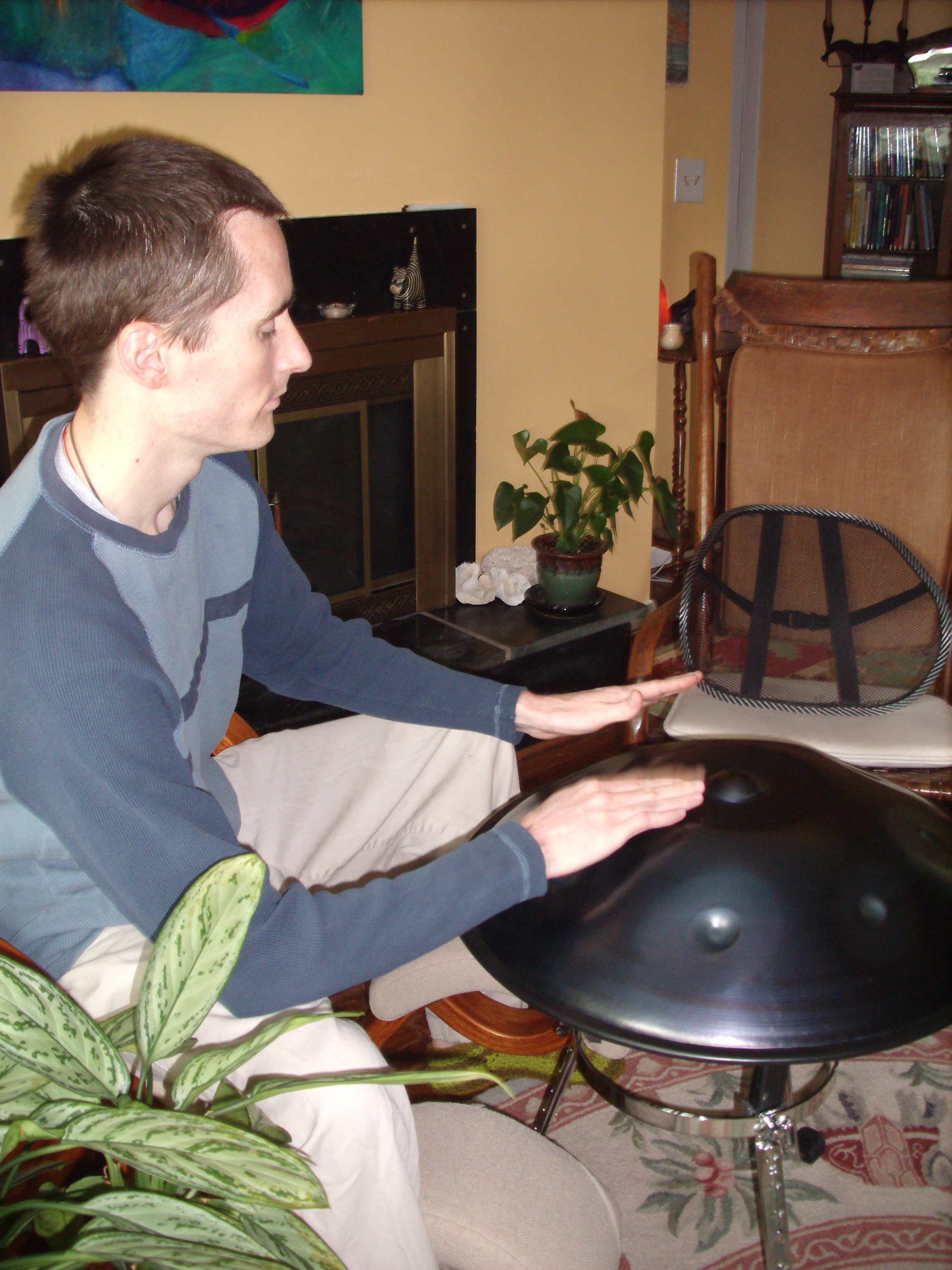
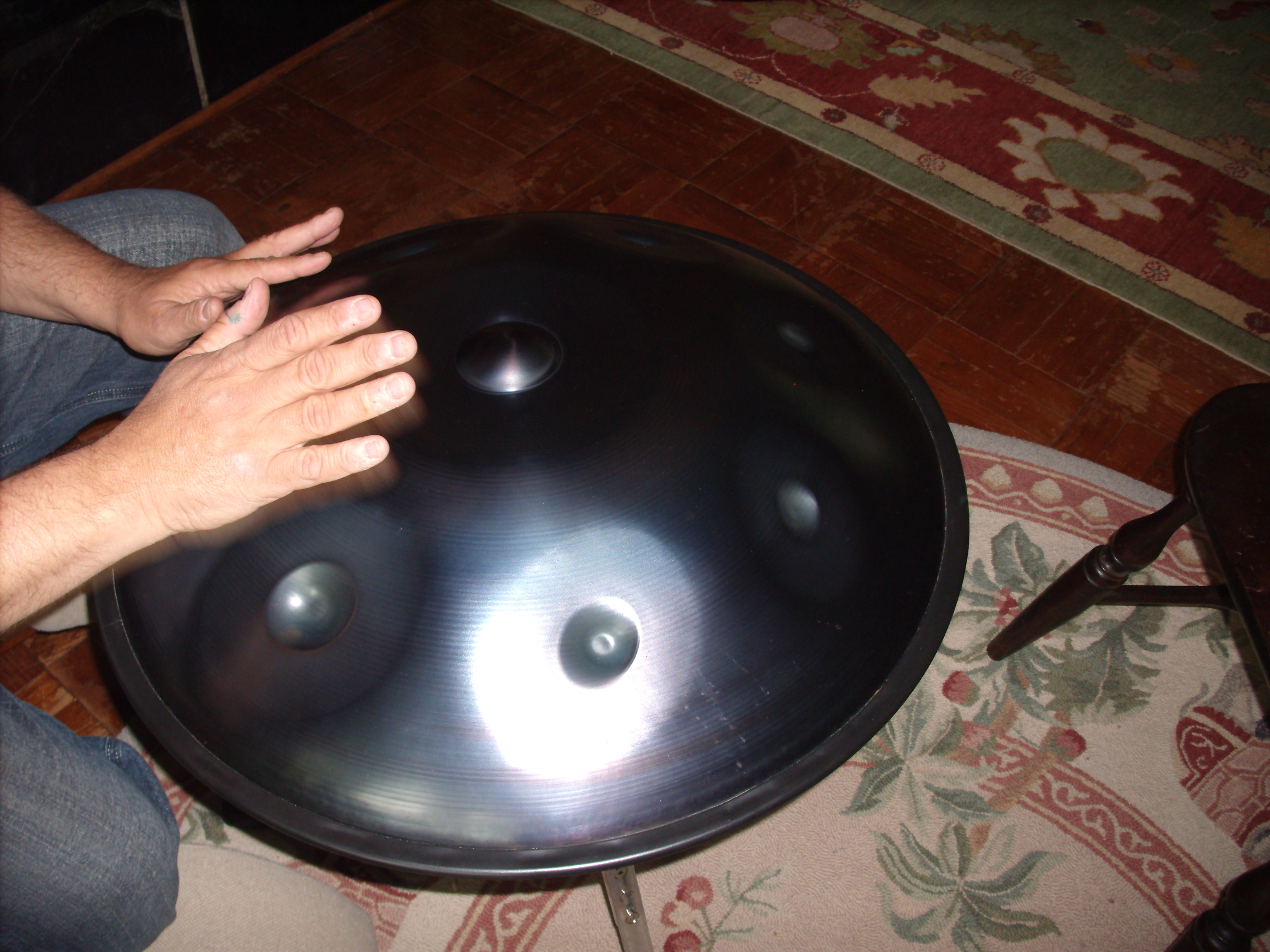
My friend who rents me healing space for my Craniosacral practice has a Hang (Drum) which is in that space. I have been using it as a tool for cathartic release for the past few months, sometimes arriving at harmonious sounds in the process. [It is difficult to get a good picture while actually playing the Hang. So here are some eyes-downcast shots of Ramanan and Kirby at play.]

Recently, my friend Ramanan Schultz and I have begun to jam away on the Hang, and we have discovered that we produce amazing little pieces. Unfortunately my recording device (which is good for voices) does not do our sets justice, so I am reluctant to post them here. However I am putting up the “best” one of four that we recorded.

The Hang is made from two steel sheets that are clamped together. It is hollow, so it looks a little like a UFO or a strange grill (stove). You play it by hitting one or more notes which have been hammered into the nitrided surface of the steel. On this particular Hang, there are seven notes around the outside with a central deep note, plus you can hit the rim to produce yet another tone. It is played with the hands like a drum.

The owner of this Hang says that this drum is more masculine, as she has a smaller higher pitched Hang in her living room. I am much more drawn to playing on this larger, deeper, more masculine drum.

The Hang has a stand which it sits upon to be played. However, from Wikipedia, it seems you can also play the Hang with it on your lap. This drum is pretty large though, so that might be awkward.

I was first introduced to the Hang drum by Toby Christensen, a healing drummer, who played this Hang and then put it on youtube. Not sure if that short video is still up or not.

In the future, I will try recording using an Iphone and hopefully that will produce better sound. In the meantime, enjoy!

Tibetan Medicine Symposium – contrasts between East and West

This post will actually be coming soon. (Sorry about the premature posting.) I typically give posts 5 – 7 days to brew as I make certain that all my ideas are well-organized, considered and articulated. This post violated that rule and did not fit all of these parameters, so I will refine it further and then repost soon. Thanks for visiting!

Tibetan Medicine and Meditation Symposium – Key Note Address

The Key Note Speech for the Symposium was given by Prof. Tenzin Robert Thurman. And I thoroughly enjoyed it. Now, I should add that I fancy myself to be an aspiring Buddhist practitioner, as well as an alternative health practitioner, so I was in agreement with almost everything he said. For someone else with different values and opinions, his speech might have quite a different reception.

Thurman did very little to disguise the fact that he actually gave a Dharma talk. But at least he gave it in a way that empiricists and academics could stomach. He had very little mythological or metaphysical information, but rather he started out by saying that the Buddha was one of the first authentic scientists, truly an empiricist. Thurman questioned whether or not Buddhism was a religion in the sense of the major religions of the world, what with the Buddha saying that no one can save us but ourselves.

I appreciated how Thurman said the Buddha recommended that we take responsibility for our health and for our spiritual health. That Buddhism suggests that a form of “karmic darwinianism” exists and that we are capable of a “conscious evolution” if we commit ourselves to doing more than Freud suggested, and go into the unconscious and subconscious realms and clean up our psycho-spiritual hubris. I appreciated this both as an alternative health practitioner (I have a private practice for Biodynamic Craniosacral work in C’ville Va.) and for the fact that I believe here in America, religions are too often practiced one day a week at best. I am grateful that Buddhism (and other religions too of course) challenges us to become better human beings in each moment. According to Buddhist theory, once we produce a cause, the result is guaranteed to follow. Therefore we must be careful / mindful what we say and do every second.

Thurman touched on this as well, mentioning that Buddhism is much much more than a philosophy of suffering which is often what is grasped from a superficial investigation of it. He said that any idiot can tell you about suffering, rather, what the Buddha found was that causation and interdependence is the letter of the law and that we must work to eradicate the causes of suffering. Then we can move toward nirvana and true, ultimate understanding.

Considering the title of the Symposium, Thurman eventually got onto the subjects of Tibetan Medicine and Contemplative Science. He said that in Tibetan Medicine, a part of the process of creating the Precious Pills, is that the Tibetan Doctors and Lamas chant mantras and prayers over the medicine to imbue and empower it. He therefore suggested that Tibetan Doctors send teams out to conventional pharmaceutical companies and to have these teams chant mantras and prayers over Aspirin and Tylenol pills before they leave the factory, thereby ensuring that these medicines have both an effect on the body and the mind of their imbibers.

On the subject of Contemplative Science, he mentioned that here in the West, we are exceptionally good at producing graduates who have high IQs and who have very clever brains. But he suggested that that was not enough. He quoted the Dalai Lama in saying that we need to teach good hearts in addition to clever brains. And Thurman mentioned that if possible, we needed to increase our EQs (emotional quotients). I definitely resonate with this.

Thurman was very humorous, sometimes bordering on being boisterous, and other times seeming a bit more restrained. I believe someone was recording all the speeches and panels at the Symposium, so maybe it would be possible to view his key note address. He had an hour in which to present, so he actually rushed for about fifteen minutes, then startled himself and us by stating, “Oh gosh, I have time!” Therefore the last half hour of his speech was more of a patient pace.

Tibetan Medicine and Meditation Symposium – the Maitri Project

This material is copyrighted by M. Kirby Moore. Reproduction without permission is prohibited. Thank you for reading and visiting.

This is the first post about the April 13th – 15th Symposium at the University of Virginia commemorating the opening of the Contemplative Sciences Center and the Arura Tibetan Medical Group in Charlottesville.

Friday had two events. The first was a talk by Judith Simmer Brown, a professor from Naropa University, about their Maitri program. The second, and more official, event was the opening evening with talks from Dr. Otsang Tsokchen, the President of the Arura Tibetan Medical Group, Dr. Tsem Gonthar, Prof. Robert Thurman, and a welcome from UVa’s president, Teresa Sullivan. It also featured prof. David Germano and the Dean of the Nursing School, Dorrie Fontaine.

I am going to write a little stream-of-consciousness here, please forgive this tangent. I just want to say that this symposium brought together one of the most eclectic groups of people I have ever witnessed (and been apart of). Scientists, meditation practitioners, philosophers, yogis, yoginis, psychologists, Western doctors, Tibetologists, Western nurses, Eastern doctors, alternative health practitioners, religious studies, acupuncturists, Buddhists, recovering Buddhists, neuroscientists, professors and humanists from all the various departments listed above, and more (there was even a famous Tibetan pop singer there)! Incredible!

Judith Simmer Brown gave the initial talk, which allowed her to have more time to discuss Naropa’s (Chogyam Trungpa Rinpoche’s creation) project called Maitri.
Maitri means loving-kindness or friendliness in Sanskrit, where it is Metta in Pali and Champa in Tibetan (I think…) In a nutshell, Trungpa Rinpoche created a series of rooms which were meticulously played with to get the right colors, dimensions, and shapes, and then he chose different postures to hold while lying in each of these rooms. And long story short, students enter these rooms mindfully and respectfully and stay for 20 to 40 minutes at a time, silently watching their thoughts and just attempting to be present with what comes up. You can go to Shambhala’s website to see more on this practice.

My take on Dr. Brown is that she is a present, equanimous, enthusiastic, patient educator who seems to be very articulate. She did not rush her presentation in any way and she was very patient with the many questions which came up afterward in the Q & A. With that said…

I must say I went through an exotic array of emotions and reactions to her talk:
My initial reaction to this description of Maitri was, “is she serious?” It looked a bit like this idea came directly out of a science fiction novel about asylums… Seriously – who would knowingly lock themselves in a purely red, blue, green, yellow or white room for 40 minutes? Something is going to come up! And when I mention the pure colors, she said everything is the same – the ceiling, the plexiglass in the window, the carpet, the walls, everything.

Okay, yes, my initial reaction was strong and considering I have a tiny bit of experience with meditation in an organized Vajrayana Tibetan tradition, you have to admit this type of lying meditation in a colored room seems a touch too easy. Could this actually “work?”

You may chuckle at my next series of thoughts… Once she started talking about how students go through little mini “retreats” in these rooms, meditating for 6 days a week, at least 40 minutes a day, for two to three weeks, I realized, “Wow, this practice might actually do something insightful, and may even be beneficial!” And then she discussed how all students who enter these rooms have some training ahead of time and they have a solid container for discussing what might arise while in this process, meaning there is a supportive atmosphere for airing whatever arose during these meditations. This was sounding better and better! In fact, the more she talked about it, the more I was curious to try it myself.

Brown mentioned each color was associated with a “Buddha family” and that each color and family had a set of traits that went along with it. For instance, red was the lotus (padma) family and it was associated with the afflictive emotion of passion (desire and lust). And within this emotion is discriminating wisdom.

Here comes the chuckling section: Once I realized the potential implications (contemplation, increased emotional intelligence, reflection, enhanced awareness, etc) this Maitri practice could have, and I realized it was being practiced at an accredited university… I had to pinch myself to make sure I was really seeing it! I could be dreaming you know. I realized that for anyone new to meditation, this was a perfect introduction – and possibly quite a potent introduction at that!

So yes, I went from initially feeling disdain and rejection of this idea to pinching myself to make certain everything was the way it seemed to then say, “That’s brilliant!” Or at least it is a good start.

I felt this was a great way to start the symposium considering half the events were to be about contemplative science. I guess I went into this talk with all my unquestioned assumptions and stubborn opinions intact, and after a little contemplation and self-analysis, I realized some of these opinions were not correct. Yes, someone might actually get a lot out of meditating, letting go and resting down in a colored room. And to have a support group around that process is a beautiful thing. [If nothing else, lying down in a colored room and staring at the colored walls would definitely have an affect on the brain’s interpretation of the messages from the cones of the eyes – the color receptors. And who knows what this might look like?]

And now on a personal note…

Maybe I was a little jealous, as my time at the University (UVa) was a bit dry. I would have loved to have any room to take a nap or meditate in, colored or not. I was never brave enough to meditate in the chapel (actually I tried once, but people kept coming and going which was nerve-wracking). I eventually found little nooks and crannies in various libraries to rest in, but come on! At Naropa, they have a class where you get credit for meditating, and lying down to do it. Holy jamoly!

Don’t get me wrong, I am very grateful for my time at UVa, but if I could change one or two things… I would. But now that the Contemplative Sciences Center is opening, and now that I discovered the UVa Mindfulness Center, along with the Center for the Study of Complementary and Alternative Therapies (a part of the nursing school)… Most of the changes I would suggest seem to be arising. The future is bright indeed I think for meditators, scientists, neuroscientists, psychologists and religious studies (especially Tibetan) students at UVa.

This incredible initiative is actually happening at UVa. I am so very happy, and I am glad I took some time away from work to attend these inspiring, dynamic talks.

Change what goes into your body

This material is copyrighted by M. Kirby Moore. Reproduction without permission is strictly prohibited. Thanks for visiting!

A post about healthy lifestyle, diet  and the little things we can do to stay healthy.  By the way (my disclaimer), I do not claim to prevent, cure, treat or diagnose any disease – rather this blog is purely informational or for entertainment purposes, and it represents a non-licensed-medical-practitioner opinion.  With that said however, health, diet and wellness have been my hobbies since 1999, so…

In 2002, when I had a little out-of-body, near-death-experience while on the operating table having my appendix removed, I started to realize that I was just a touch different than the average American male. It only took three or four years to make the changes which the Universe immediately began to show as being necessary (I am also very stubborn). But I began to make little tiny changes in my diet and in my lifestyle choices which were suggested to me by friends and co-workers and healing facilitators, etc. And I am still doing most of these to this day.

I think I am mostly a spiritual being having a human experience. Of course I am an ordinary human being, but the pursuit of increased consciousness is important to me. Therefore, obviously I am a touch different from the average American male. So if you feel that you might be a slightly higher frequency being (one who seeks to transform their consciousness for the better, someone who is trying to stay on a spiritual path, someone who meditates regularly, or someone who takes responsibility for mistakes, etc), male or female, then these suggestions might benefit you. With that said, you don’t have to listen to any of these items, and of course, if you do, consult your doctor before changing your lifestyle / diet.

So here are some suggestions of little changes you can make to your life which I believe will slowly improve the body / mind system. I do not believe we can really separate the body from the mind – for if the body is stressed, how can the mind relax? (Unless you are a sublime being… but for the rest of us…) And likewise, if the mind is stressed, does the body relax?

Generally it takes months and / or years to make significant changes. So please don’t beat yourself up if you do all the “no-no’s” on this list. Rather, slowly (maybe change one item every few months) make a healthier choice. Please do be gentle. We all start out at different levels and with varying degrees of discipline. So for goodness sake, don’t be harsh toward yourself just because you have limits! Rather, be kind.

The list of slight changes for a healthy body:

Rather than big name brand toothpastes, use a non-fluoride toothpaste. There are many to choose from. So you can still get your flavor, or your level of abrasiveness, etc.

While I am on this subject, if possible, filter your tap water. It seems strange that low levels of arsenic / lead / mercury, and not to mention chlorine and fluoride are allowed in to our drinking water. You want to filter out the larger chemicals while keeping in some of the minerals. For instance, drinking distilled water can rob the body of some of the necessary minerals it might need.

If you have mercury amalgam dental fillings (the silver which is actually mercury ++ in your teeth), when you have the financial ability, have those fillings replaced with less-toxic resin fillings. And only go to see a dentist who knows what they are doing around this – not all dentists are created equal. There is special equipment for the removal of mercury, which begs the question of, “how is the mercury non-toxic in my teeth, but when you go to have it removed, they must install a special mercury-catcher to prevent any from being swallowed?” Huh? [Hopefully the ADA does not flip out upon reading this… purely informational! Please seek out and ask an expert before making any changes. I’m not responsible for anyone changing their lifestyle without consulting a licensed practitioner.]

Avoid antiperspirants that contain aluminum. If unable to do so, then only use it on a really busy / hot / high-pressure day.

Use eco-friendly laundry detergent. Having used non-abrasive detergents for several years now, if a friend happens to wash something of mine and they use a major name brand detergent, or some other chemical laden cleanser, my skin itches and I can smell the chemicals out-gassing from the fabric. Yuck! (And if this happens to be something I am trying to sleep in or on… good luck sleeping that night!)

When the weather turns cooler, brewing your own Kombucha might be in order. Kombucha is warming though, so it might be best to avoid drinking it during the hot summer months when the body would rather have cooling foods / drinks. See one of my previous posts about brewing Kombucha.

Avoid partially hydrogenated oils / fats. That means avoid some commercial, big name nut butters (peanut butter that has these PH oils seem more like wax or plastic than food to me). And palm oil is not much better – if possible, go for peanuts only peanut butter, which means you will have to stir it up as the oil separates. Also true for cashew butter, almost butter, sunflower seed butter, etc.

And remember, please speak with a licensed practitioner about all these things. I am not responsible for any adverse reactions to changes made in anyone else’ lifestyle or body.

And the final suggestion for food changes – dump as many processed carb foods that you can, including cereals, big-name-brand breakfast bars, etc and especially avoid foods containing high fructose corn syrup as you don’t know if that corn was genetically altered (further adding confusion to the body’s digestion) and no matter what, it will wreak havoc on your blood sugar. Best to avoid those spikes and crashes I say. Better to eat whole grains, cook your own rice, quinoa, buckwheat, millet, barley, whole grain pasta, etc.

Rather than using pharmaceutical drugs, whether prescription or over the counter, try using homeopathic medicine (seeing a homeopathic MD is best for this), or perhaps try flower essences / essential oils (maybe a Naturopathic Doctor would be best for these, or an alternative minded Registered Dietician). For instance, Arnica (homeopathic) is a good replacement of over the counter pain relievers and it is definitely less stressful on the liver.

There are many good herbs which help us to relax and / or go to sleep. And if we are stressed or traumatized (or near the verge of going into shock), then having Rescue Remedy around (flower essence blend) is very beneficial and it works wonders! Talk to an alternative health practitioner, and preferably one who is licensed about these.

And remember, find a quality health care practitioner who you trust, and ask them about any of these suggestions. Then go out and get a second opinion! You can also go to Dr. Mercola’s website to investigate health rumors and other dietary suggestions. That would be http://www.mercola.com

See also Terri Saunder’s website – Sunrise Herb Shoppe from my blog list on the RIGHT and you can read many of her well-researched articles on these subjects and more.

Thanks for reading.

A Brief Discussion on the Progressed Moon in the 6th House

This material is copyrighted by M Kirby Moore. Reproduction without permission is prohibited. Thank you for visiting! You can visit http://www.mkirbymoore.com to see what Kirby offers.

Progressed Moon in the 6th House

This is a post about a topic within Western Astrology, and as a result, I am writing for people who have a limited to moderate understanding of Western Astrology. Without such a background, you will still get something out of reading this, but you may not grok the slightly technical language. Specifically this post is about the Progressed Moon, which moves through the chart at approximately one degree per month, meaning it is in an Astrological House for an average of 26 – 30 months. Therefore we have small two plus year cycles as the Progressed Moon moves from sign to sign and from house to house.

Trauma-Informed Astrology Special

One Hour Astrology Interpretation. Get your Astrological birth chart interpreted from a Spiritual / Karmic / Evolutionary perspective. You name the topic (area of the chart) and we can dive in - these are some possible areas to look at: Timing Astrology, Relationship Astrology, Medical Astrology, Natal Astrology, Psychological Astrology. Thank you!

$150.00

The sign does make a difference. However, some of what I am about to describe will pertain to anyone’s Pr. Moon in the 6th House, no matter what sign it is in. There will be a recognizable difference though between a Pr. Moon in an earth sign (Taurus, Virgo, Capricorn) which resonates with the earthy 6th house, versus being in a less grounded sign like Pisces, Sagittarius or Gemini for instance.

So what does the Pr. Moon in the 6th house mean? Remember the Pr. Moon will be in the 6th house for at least two years and possibly closer to three years. It is a time of preparation. It is a time of completion. It is a time of increased self-discipline. And it is a time to relish resting in the discomfort of appropriate growth. In the following paragraphs, I will unpack each of these concepts further. A) Preparation, B) Completion, C) Self-discipline, and D) the Discomfort of Appropriate Growth.

It turns out that A) and C) go quite well together, and while we are at it, we should probably throw D) in that same mix as well. What do I mean? Well think about the Astrology Chart from a larger perspective. The 1st house through the 5th house reflects a time (or essence or energy) of Self-Orientation. And then, the 7th through 11th houses have to do with a more public, other-orientation if not community-oriented perspective (or energy or essence).

So where do we transition from a Self-Oriented perspective to a more community / other / public perspective? Well of course, the House of Bridging-Consciousness, and Maturity, and Discipline: the 6th house.

And then we can also take a more focused glimpse of the Astrology Chart, and compare the 5th house with the 7th house. Because, like it or not, the 6th house is intimately connected to both of these fun-loving houses. Unfortunately, in order to get from the 5th house to the 7th house, we must go through some significant changes… Ugh! Right?!

Donate to Kirby’s blogging efforts

For every $25 you donate, Kirby will write a blog post (article) on the topic of your choosing, within his areas of knowledge. Thank you!

$25.00

[By the way, the following description of the 5th and 7th houses, along with the succeeding discussion on Neptune, is overly simplified and drastically exaggerated to make a point. In reality, Western Astrology is a very complex subject and you should investigate it thoroughly if you are interested. Please don’t read this post out of the context of the larger astrological understanding and start making judgments about Astrology, your chart or others’ charts.]

The 5th house is the house of FUN. It represents Creativity – Artistic, Theatrical, along with Procreation (it is the house of children nonetheless – and making children can definitely be fun!). The 5th house also has to do with Gambling or Speculation – Love Affairs, that is the early stages of a romantic relationship; Having Children, as we never quite know to whom we are going to give birth; and of course Taking Risks – gambling with our body or with our money (or emotions), it all falls under this house’s influence. Basically the 5th house is the house of partying and living it up. It represents some of the best traits of Leo (fun-loving fire). The 5th house, like the lower frequencies of Leo, can be a very Self-Oriented house – how much money can “I” make with this risk? This love affair is fun (for me)! “I” am going to stay with it. But if it gets serious or dry, responsible and deeply-committed, forget it!

Then we have the 7th house, which, in some ways, is a polar opposite of the 5th. The 7th house is the house of Compromise, Union, Negotiation and being a mature, participating partner in a dyad (Partnering). Many astrologers, both traditional and contemporary call this the House of Marriage, with good reason. Because maintaining a marriage takes work (not that I know from personal experience, but I have closely observed healthy marriages – and they are not all ease and grace!), it takes maturity and the humility to admit that we make mistakes and taking responsibility – all the stuff the childish 5th house type detests! Making repair is a part of living. Expressing your boundaries is necessary in a healthy relationship, and when they are violated, repair is necessary!

So how do we get from this adolescent 5th house to the mature, responsible, vow-taking 7th? Well, yet again, I don’t have to tell you – we go through the nitty gritty process of growth and maturation in the 6th house. And when I say that you need to get used to the discomfort of growth, you may want to pay attention. And not only get used to, rather, we must start to relish the discomfort, sit in the flames of wisdom fire and allow the Creative to shape and mold us into a mature, responsible (hopefully wiser) being.

Refining is a good word to describe what is happening to the soul during this period, but I feel it is too graceful or soft a word to touch on the depth of angst and the death-struggle of wrestling with our ego that is possible when the Progressed Moon tenants the 6th house. And it may need to be intense to kick us out of our old, childish habits.

That is why people talk about the 6th house in a slightly dry or possibly dreadful way. It is not a bad thing to grow, but it is rarely ever comfortable! And if it is, either you started with incredibly positive karma or you are grossly deceiving yourself, and as a result you are setting yourself up for a series of nasty disillusionments as we speak. (Sorry to be the bearer of bad news…) But in reality, becoming more responsible, more reliable, more attentive to details and more mature are never bad traits. It just depends on where we are starting from as to how difficult a journey it is.

If we are younger when the Pr. Moon enters the 6th house, say between 18 and 30, then this could be the time of preparation for our first serious committed emotional / romantic relationship (or possibly our first and hopefully only marriage). And many of us are not that aware of who we truly are at this point, which means there might be additional relationships coming up in the future. But, if we seek out and listen to the advice which is readily available when the Pr. Moon is in the 6th house, then we have a chance to grow in many positive directions.

Comprehensive Natal Chart Interpretation

Kirby will spend 90 minutes interpreting your Natal Birth chart. You can chat about any area that you like. This includes printed charts and it also includes about 30 minutes of preparation time! These are typically done on the phone, via Skype or in person if you happen to be in Virginia, USA.

$150.00

If we are more Neptunian types (lots of planets in Pisces, or in the 12th house, or if Neptune is making Hard Aspects to the natal Sun, Moon or Mercury), then the journey to become Grounded, Responsible, Reliable, and Mature in a worldly (positive connotation) sort of way will be more difficult. Because which planet detests being structured and contained? Think the foggy, watery essence of Neptune – it is the one planet that prefers to be in any other Creative World besides this one. Not to leave you Neptunian types in a lurch, I myself have heavy Neptune aspects (and Pisces Sun) in my chart, and through diligent work and with alert / relaxed awareness, one can become more embodied in the present, and more grounded in the world. It is possible! (See my previous posts for more.) But don’t expect it to magically happen on its own – you must put some effort into grounding and do your personal growth work, as no one else can do it for you.

Therefore, before we try to decipher what the Pr. Moon in the 6th house will mean, we must discern where we are coming from. How attached are we to our “me-first” ego (5th house)? Are relationships easier for us – can we be practical and express our needs with ease within them (some of the best traits of the 7th house)? Are we more at home in a creative timeless possibly substance filled evening (Neptune) or are we naturally more practical and responsible? And don’t get me wrong – there are people who need to get more in touch with their Neptunian sides (emotional intelligence, creativity, intuition, psychic abilities, compassion, empathy, etc). But there are people who err on the side of all of the above traits and who seem to be light-years away from pragmatic conduct. So discover who you are, where you are on your path, and then start to peel away the layers of the Progressed Chart and its interpretations.

[Edited Nov 2017: Reading through this post, I wonder how I did not mention the following about the Progressed Moon in the 6th house: if there is one Astrological house where you will clean up your act as it were, become more active in your lifestyle – go to the gym, start hiking, join a biking club, pick up that river kayak that has been sitting in your shed for 5 years, etc; this is a time when you will probably clean up your diet – you might start reading books on healthy bioflora, you might do a specific diet, but you will probably be more aware that you want to tidy up your eating habits, and you may even do a cleanse (see my posts about this topic however); and you might also add some other healthy habits of self-care during this time – maybe you will pick up yoga, qigong, tai chi, martial arts, walking daily, receiving a monthly massage or bodywork session etc. It is a time of moving toward health when Progressed Moon (or Sun or Mercury) pass through this area of the chart.]

Universal poetry

Hi, I wish I could claim this poem as my own, because to me it seems to have themes of Buddhism and Craniosacral Biodynamics streaming through it. The universal intelligence interpenetrates all form and with Buddhism, form is emptiness (perhaps a living, breathing, pulsing, luminous emptiness). I will seek out the title… (don’t know it at present).

By Rabindranath Tagore:

the same stream of life that runs through my veins night and day
runs through the world and dances in rhythmic measures.
it is the same life that shoots in joy
through the dust of the earth in numberless
blades of grass and breaks in tumultuous waves of leaves and flowers.
it is the same life that is rocked in the ocean-cradle of life and death,
ebb and flow.

Taking advantage of quality UVa programs

I graduated in May, so my knowledge of UVa activities and academics is still fairly fresh. I graduated with my BA in Psychology, along with taking five semesters of the Tibetan language to satisfy my language requirement.

Therefore, this post will mainly discuss the merits of some of the Psychology classes and professors at the University, and I will mention a little about the Tibetan program.

About the Professors:

Brian Nosek, James Coan, Karen Schmidt, John Haidt, Peter Brunjes, David Hill, Angeline Lillard and Timothy Wilson were all top quality professors who I took classes from or worked with. Dr. Nosek’s class was Psyc 101 – he always had music going with the theme of the song having to do with the topic of the day. Very engaging and highly entertaining! Dr. Coan was my advisor. The first day I walked into his office, he was wearing a casual button down long-sleeve shirt with his sleeves rolled up, cut off shorts and red converse high tops. Needless to say I asked him where Professor Coan was! Well, it was he. And he is a modest, awesome dude! Karen Schmidt is probably the primary reason I graduated as I struggled to get through the 3005 / 3006 courses (I dropped each before completing them) and she made this material (research methods and data analysis) very engaging and approachable. Dr. Haidt is well known for his work with positive psychology – a very interesting field to be certain! I took my bio-psych classes from Dr.s Brunjes and Hill, 220 and 420 respectively. They are hilarious! In fact, they tended to play pranks on each other, sometimes in class and sometimes you would hear the humorous stories about various gags. Very enlivening professors! Dr. Lillard was a very strict but engaging and passionate professor. I enjoyed her class on Child Psychology. And finally Dr. Wilson was sort of my surrogate advisor. It seems he is one of the gurus of Social Psychology. Very cool!

As I mentioned in my previous posts on my UVa experience, I am very glad for my time at the University. It was like a form of mind training. Refining and grinding my intuitive, feeling, impulsive mind down while building up an empirical, diligence-sustaining and focused one. Plus my connections within the Religious Studies department and among grad students (I started UVa when I was 28) really helped.

Now a bit about the Tibetan program at UVa. I realize Tibetan is not the first language you think when you consider fulfilling your language requirements. In fact, you may not even realize UVa offers it, or that it is a language at all! Some of the people I work with are of Hispanic backgrounds and they ask me, “What is Tibet? A country? A culture? A place?” (They are exceptionally kind-hearted, sharp-witted, altruistic individuals, it just seems some of them do not keep track of world events.)

Well, if you need to take an elective and are not sure where to look, you might want to peek into Tibetan. I say this because UVa has one of the best Tibetan professors in the world, and I’m not exaggerating. His name is Tsetan Chonjore and he wrote one of the top Tibetan language books that is on the market (of course there might be ten out there total…): “Colloquial Tibetan.” He took a lot of time working with linguists and other scholars to get it right.

It is not an easy language, so be prepared to work, but you will be rewarded when you do. Prof. Chonjore (or “Gan la” – meaning “teacher” in Tibetan) is very engaging, humorous and filled with equanimity. He is a part of the UVa Tibet Day which happens each spring semester around Losar (Tibetan New Year which is usually somewhere near late February – they are on a lunar calendar) and it’s primary purpose is to introduce Tibetan culture and academics to fellow UVa students. So you should check it out if possible. Oh, and there are very, very few schools that offer Tibetan at all, and UVa offers it year round. It has one of the best summer language programs in the world, where you can get credit for four semesters of language in less than nine weeks (they don’t call it an intensive for nothing!).

Somatic Moves to Well-being, senior style, Part IV

This material is copyrighted by M. Kirby Moore. Reproduction without permission is prohibited.

This post is a continuation of a descriptive piece from mid-March when I taught a class on relaxation and stress-relief to seniors. I’d recommend scrolling down and reading Part I through III to get some background info.

I want to start out by saying that I mentioned those first two Zapchen exercises only, and I want to stress this word, ONLY because we all know how to Yawn and Nap. There are some exercises which Julie Henderson came up with which inspire embodied awareness and increase potency, but if these techniques are not natural to us, then I’m not going to mention them.

In other words, there are some playful, fun techniques for coming down out of the head and resting deeper in embodied sensation and presence. Some of these exercises we learned as children, and then we have spent how many years as adults un-learning them! Well Zapchen includes a few such exercises to remind us what it is to be fully human – in touch with a light, loving heart, a potent, full pelvis and a clear, wise mind. Zapchen also includes some new techniques which we have had very little exposure to, let alone tried to do them ourselves. Maybe you could call these Zapchen Yoga, although I think it is all Zapchen Yoga.

Therefore, I am not going to mention the third exercise that we did. Oh, the suspense! Well, you will have to come see me for a session to find out. 🙂 I will skip instead to the fourth technique that we did, as this inspired the most laughs and humor anyway. So hopefully this is remotely entertaining:

The fourth exercise we did is called, “Funny Talk.” It has serious somatic effects on the body, so please, only try this at home if you have some time and patience on your hands, not to mention a talking buddy who is open and ready to let go 🙂

When we do Funny Talk, we put the tongue behind the lower teeth, touching them and then allow the tongue to fill the base of the mouth.  Yes, then you talk. It should sound funny, or at least not at all serious. Honestly, who can take themselves seriously when they are talking like this? Oh, and I should stress that there are researched, profound relaxation effects of doing this AND the exercise is by NO means a method used to mock anyone. If it is, then it is not Zapchen.

Well imagine doing this exercise with seniors, I guess who range in age from 65 to 80? Not sure about this though – they had gotten all dressed up as they wanted to look good for the class (apparently, I was told later). It was very precious. But I digress, yes, imagine doing Funny Talk with 12 seniors, the majority of whom have dentures… Here are some snippets from the class, and again, I am merely trying to be a reporter, not mocking anyone! Because one day, relatively soon, if I make it that far, I will be old too.

The woman next to me tried it and then exclaimed, “Oh my, I might push my bridge work out.”

Soon, a few seats down, a lady commented, “I would use my teeth if I had them in!”

About thirty seconds later, the retired beautician (with the hearing aids) exclaims, as if just registering the previous conversation, “I can’t push my teeth out – they are glued!”

A few minutes go by as I check in with other students, with a hushed conversation happening across the circle of chairs, and the beautician again, exclaims with a loud word amidst the whispers, “Polydent!”

We all burst out laughing, including her. I can feel parts of my skull and brain literally re-orienting as the laughter and the funny talk and the previous exercises work their “magic.” Then the lady next to me pipes up with,
“You know, this would be a great commercial for Polydent!” I could not agree more. Why hadn’t I recorded this class? 🙂

All in all, I was very happy to have gone down there to lead them. I kind of doubt they were expecting to slow down and practice this radical form of kindness… but they were happy nonetheless. I say this because I was very careful to not talk about coming back (they would have to formally invite me, especially with my not be an official teacher and all). So guess what?

The lady who has the magic touch with plants asked me first, “Will you come back and do this again?”

I asked, again just to be clear, “Is that a request?” Yes!

Oh – I had been asked earlier to keep going after the Funny Talk. One woman was just drinking in the neurological nourishment of these potent exercises and she wanted me to teach more. Nope! I responded, “I need to stick with my teachers’ advice and tell you that Less is Better than More. Please go back over the next few weeks and practice these exercises. Find one you like and stick with that one. Allow it to be fun and easy. Then I can go through some more.”

And then everyone seconded (and thirded, etc) the motion of having me come back. So I discussed it with the woman who originally scheduled me and we have set up a second day, about a month from now. I hope that goes as well or better than this class!

Some very wise words were shared amongst all of us. I learned much more than I taught for certain – don’t read a book by its cover, always be grateful for each breath you take, and value good friends and good company very dearly!

And if you happen to fall asleep in a chair, which is definitely not the norm for you, mutter “Sweet Jesus!” over and over until you feel better about the situation. 🙂

Thanks for reading.