Leh, Ladakh June 2008

This material is copyrighted by Kirby Moore.  Reproduction without permission is prohibited.  To support my business and blogging efforts, please visit my website. More recently, I have begun teaching Astrology classes on Trauma-Informed Astrology, see http://www.traumainformedastrology.com for more! Thank you for visiting!

6/19/08 – This was a day of adapting to the Ladakhi altitude / food / new world experience.  In my journal I kept track of my experiences – both in the waking and dream realms.  I mention this because I was sick (sore throat) and I must have napped off and on, because I have about half a dozen dreams jotted down.  In one of my dreams I am wondering where to park my camel – go figure!

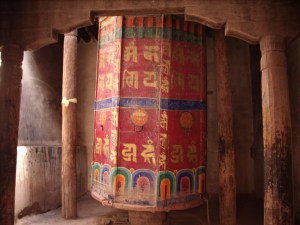
Large prayer wheels, common in Ladakh

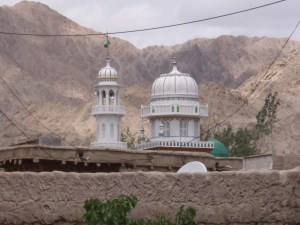
We walked around the markets of Leh.  The guide, Namgyal, gave us a walking tour of Leh – its Muslim mosques, dozens of huge prayer wheels, the inside info on which markets to frequent (i.e. who owned them, the quality of the merchandise, where it was from – whether Kashmir, Tibet or Ladakh, etc).

There were dozens of fascinating sights – large stupas including one that we walked through and under, the minarets of mosques near and far, a monastery on the large hill overlooking the town.  There were little stupas colored yellow, white and blue representing the three primary Buddhas.  I believe the yellow represents Manjushri (wisdom), white is Chenrezig or Avalokitesvara (compassion) and blue represents Vajrapani (potency).

Stupas of the three main Buddha emanations

I really enjoyed spinning the large prayer wheels, the ones that are so heavy that one person can turn it with a lot of effort or several people can get them going pretty quick.  They are on stainless steel poles which support it along with a hanging bell that gets “Clink”ed each time it rotates.  Therefore you could always tell when we went by one because the bell would be ringing for several minutes afterward.

These prayer wheels were intricately painted, sometimes carved, always colorful with golds, reds and a large spectrum of the rainbow.  Namgyal said that the large ones (5 feet in height) had over a million prayers in them, with the smaller ones having ten to one hundred thousand prayers.  I have an aspiration to put a large prayer wheel in my house or elsewhere in Charlottesville.

The main mosque of Leh, near the market

In one of the Tibetan markets, I met a new friend, a Tibetan refugee named Tamding Tsetan.  He told me his name meant (Tsetan, Tamding) the powerful lifeforce of the fierce, wrathful, horse-headed, mountain protector, hopefully that is not too far off.  He was very kind-hearted and generous, sharing tea and a unique tasting lime drink with me on several occasions, not wrathful in the least as far as I could tell.  I feel that he and I have some good karma, because he ended up showing me around the different Tibetan markets and introducing me to other vendors.  I also hung out with him when the group left and I was in Ladakh for a few days longer.

hidden wisdom

This is a little reprieve from the Ladakh pilgrimage files, as I need a break.

This material is copyrighted by Kirby Moore.  Reproduction without permission is prohibited.  To support my business and blogging efforts, please visit my website. More recently, I have begun teaching Astrology classes on Trauma-Informed Astrology, see http://www.traumainformedastrology.com for more! Thank you for visiting!

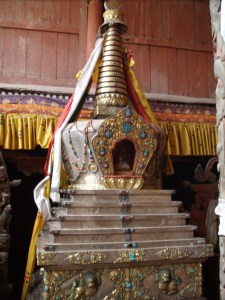
Stupa from Shey palace, Ladakh India, capped in gold

Recently, a friend commented on how I started out being smart, however, now, it seemed to him that I am becoming wise and he said it is a great process to observe.  What a marvelous compliment!  Thank you!

Here are some quick thoughts, though, off the top of my head:

Any wisdom I possess, due to my being an afflicted, ordinary human being, has arisen merely due to the blessings of my teachers and Tibetan lamas, whose wisdom and compassion is as vast as space.  I am very grateful and blessed to have met my heart teachers – beings who have taught Bodhicitta (agenda-less, unconditional loving-kindness and compassion for all).

In order to have authentic wisdom arise within our mind stream, it is mandatory that we study under one or more fully qualified, experienced teachers, who are connected with a long, unbroken lineage of healing wisdom.

Wisdom is not something we acquire, rather, I believe we gradually gain clarity about its essence (it is has been here all along, our minds have just been too busy or afflicted to perceive it.)  Not unlike polishing a grungy mirror – slowly, its shiny reflective surface will give clearer and clearer images.  Oftentimes, it takes lifetimes of learning (or unlearning to get there).

Wisdom is letting go, releasing the clinging to hope and letting go of the icy grip of fear; (somatics exercises such as Zapchen and/or process-oriented bodywork really come in handy for allowing the causes and conditions for doing so to arise – for releasing old stuff from both the body and the mind.)

Wisdom is recognizing the attachment to pleasure and the conditioned reaction to pain, and breathing deeply and mindfully in spite of it,

Wisdom is accepting yourself for who you are, as opposed to fanciful, over-idealized dreams of fame or revulsion of anonymity, first find happiness within, then if fame or isolation arise, it is okay,

Wisdom is resting in equanimity, being neutral (non-attached) to praise or blame.

ornate stairs, Stakna gompa (Tiger's nose), Ladakh, India

ornate stairs, Stakna gompa (Tiger’s nose), Ladakh, IndiaI believe, that if we have the blessing and good fortune to attend a fully qualified teacher, then, unless we are on solitary retreat, we need to be participating in the world.  Sharing gentle healing words and presence and confronting ignorance when we come across it.  (Take a little risk here and there!  Then check in and see how we are doing, are we in alignment?)

Finally, to add a possible provocative ending, I feel that, if appropriate, a part of the process of healing and becoming more wise, is the realization that the pervasive concept of “original sin” is erroneous.  Original goodness leads to a deep foundation of health and ease.

(Most of this advice is what I have heard from my teachers, in my own humble words, particularly regarding the eight worldly Dharmas.  Please note that I am just an objective reporter and passer-alonger of the wisdom I have been so blessed to encounter. But any mistakes are my own.)  I dedicate any merit arising from these words to the benefit of all sentient beings, particularly authentic spiritual teachers – may their paths be clear for disseminating wisdom and compassion.

Phyang monastery (gompa), Ladakh pilgrimage cont’d

Sand Mandala at Phyang Gompa, June 2008

This material is copyrighted by Kirby Moore.  Reproduction without permission is prohibited.  To support my business and blogging efforts, please visit my website. More recently, I have begun teaching Astrology classes on Trauma-Informed Astrology, see http://www.traumainformedastrology.com for more! Thank you for visiting!

6/18/08 – cont’d – The guest house was cozy, yet open and comfortable. Some of the decorations reminded me of a Californian yard sale – a little bit of this, a little of that (Western styles). There would be 16 of us once we all arrived, and we had the guest house to ourselves as a result. We were given breakfast and tea when we arrived – the “dining room” was typical of Ladakhi eating spaces. We sat on slightly raised cushions behind low, beautifully carved tables. There was a short 14 year old boy named Sonam, a cousin of the owners, who served us for the most part. He was enthusiastic and happy, plus he enjoyed singing to himself. Sometimes he had help from someone hired in the city. The family who owned the guest house prepared the food.

We rested a little, before heading out to Phyang Monastery, where His Holiness Chetsang Rinpoche was staying. We were in luck for multiple reasons that day. The monastery was just completing a week-long ceremony, leading up to and celebrating Saga Dawa – Buddha’s Parinirvana day (which is apparently the most sacred day in that Holy Month). They would be dissolving a sand mandala, bringing the sand down to the river and blessing the waters with it. And we were seeing His Holiness on Saga Dawa.

Monks at Phyang Gompa, completing sand mandala dissolution

Therefore, we got to see the monks playing all the instruments – long horns, hand-held clarinet-like instruments, drums large and small, cymbals, bells and a conch shell. The parade of monks exiting the meditation hall was very colorful, and full of life. The monastery had 78 monks, supported by the local villages and the Drikung Kagyu in Ladakh (and tourists / pilgrims like us). The monastery was typical of Ladakhi architecture – white washed walls for the most part with red painted trim around the tile roofs and wooden doors. For most monasteries, the protector shrine was generally always distinguishable from the rest of the gompa (monastery) – usually painted red. I believe this was the case at Phyang.

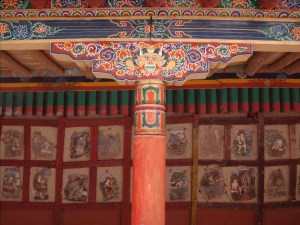
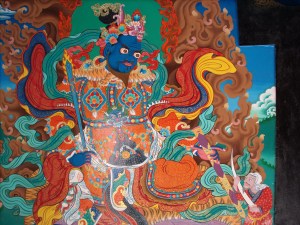
Every monastery we visited had incredible paintings – sometimes, nearly every surface was painted – whether stenciling on the banisters and support beams, or large, vivid murals on the walls, or aged thangkas hanging in meditation halls.  In some cases, even the ceilings would have murals on them (see Chemray gompa later on). It was an amazing dichotomy – the stark, desiccated landscape versus the bright, colorful monasteries. I was told that this purposeful (it contrasted the rich, colorful inner life of a Buddhist contemplative vs. drab outer life of toiling in samsara).

Tall mast (pole) with flags and yak hair at the top, Phyang, June 2008

Phyang is built on a long, slender hill, making it similarly shaped. There were a long series of stairs leading up to the main level of the monastery. And due to the ceremony or the fact that a high lama was in residence, there were Buddhist symbols drawn on the concrete with chalk (the eight auspicious symbols). First we toured the main hall, which was where the sand mandala was – in its curtained splendor. We took pictures of the mandala, the statues, the gorgeous thangkas and the murals. Then we watched as the monks began the dissolution ceremony. There were at least 80 to 100 locals – both Ladakhis and Tibetans – at the monastery, also watching the procession of monks pour out of the meditation hall. There was an incense burner on chains, which the monk holding it would swing, reminding me of a Catholic service.

After the monks had all filed out on their way to the river, we toured the rest of the monastery. There was a large kitchen, separate from the other buildings, along with a protector shrine and several smaller shrines – one housing many statues of Green Tara. One of the smaller shrine rooms had pictures and statues of the lineage masters. We had to climb several sets of stairs – steep, old, well-trodden wooden ones, basically ladders – to get up to His Holiness’ level. There was a long line of people (mainly Ladakhis) waiting to receive a blessing from the Drikung Kyabgon. We also waited. And waited, observing the murals painted around the entrance. At the time, I thought we were just being polite, waiting for everyone else to go and letting people go in front of us. But then, when we got in to see him, I realized we were waiting because we were invited to have tea with His Holiness, Chetsang Rinpoche.

We received our blessing in the traditional manner – we offered silk scarves, called khatags, which His Holiness draped around our lowered heads. Then we sat down and took in his presence. It turned out that his reception room was on the top floor of the monastery – literally. The wind was whipping around, making windows fly open and closed, also causing the prayer flags to snap in the gusts. That in and of itself was an experience, and then there was His Holiness. Chetsang Rinpoche was very kind and generous – giving us protection cords, offering us tea and cookies and most importantly, his blessing. He seemed like a simple monk, ordinary in his knowing and purposeful actions, until you looked into his eyes. They were twinkling and sparkling which led me to believe there was more to him than he let on.

It turned out the trip leader’s family, who is from Malaysia, are patrons of His Holiness, so they had a connection.

View from Phyang, line of Stupas on the way to the river

They chatted about the Kyabgon’s recent activities, how his monastery and library were doing. His Holiness was asked if there was a brief bit of advice he could give us. He consented and told us about the four thoughts that turn the mind toward enlightenment.  [In case you are interested in “what are the four thoughts?” acquire and read the book “The Transformation of Suffering” by Khenchen Rinpoche, Konchog Gyaltsen.]  Finally we got up and thanked him and ventured back down to our vehicles.

By the time we got back to the guest house, another meal was just about ready. The owners of the guest house took great care of us, wanting our every need to be met. It turned out several people needed to rest as they were experiencing some altitude sickness.

About Ladakh, physical terrain, the people, society

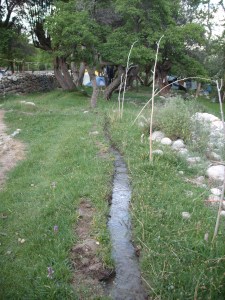
Some of the incredible irragation networks in Ladakh, Nubra Valley

This material is copyrighted by Kirby Moore.  Reproduction without permission is prohibited.  To support my business and blogging efforts, please visit my website. More recently, I have begun teaching Astrology classes on Trauma-Informed Astrology, see http://www.traumainformedastrology.com for more! Thank you for visiting!

In Ladakh, the overall terrain is desert-like. It is very arid and dry for the most part. Therefore, the Ladakhis have become expert at the art of water irrigation. They had little trenches that would run alongside creeks or branching off, sometimes traveling miles before reaching their destination. When we were driving around Ladakh, we would primarily see dry, rocky terrain, sometimes sandy deserts, at other times it would look like we were on the Moon and yet in at least one location, the dark reddish hue could have been Martian. But, wherever there was flowing water, there would be little oases of trees and a few houses, sometimes villages of several dozen houses. It was a visual adventure to track the water by following the path of greenery.  The city of Leh got most of its water from a glacier, high above it.

I believe I heard that 95% of Ladakh is desert-like, leaving very little land to cultivate and live on. Ladakh is a fairly large region (maybe similar in size to Texas or France?), but due to its incredible mountains and dry landscape, there are only 150,000 permanent residents. In the summer months, this number might swell to an additional 25 – 35 %. Leh, the capital and main city in Ladakh, has a population of over 20,000 in the summer, as many merchants and workers come in for the few precious warm months to earn some money and entice tourists looking for Kashmiri products. There are a large number of Tibetan refugees living in or near Leh, and their presence was obvious with the dozen or more markets that specialized in Tibetan products. There is also a school for Tibetan refugee children, which I learned about later.

I was in Ladakh for about a month, and it really only rained once. It sprinkled a couple of times, but nothing much in the way of accumulation. I forget the actual numbers, but some months in Ladakh receive very little rainfall (think parched desert). Then there are six months of hard winter, where there is generally always snow on the ground (Oct – Apr).

Glacier above Leh, Ladakh, India, 18,500 ft

Briefly, to describe the custom of working (or not), Ladakhis are pretty much all the land owners in their country and they hire people in the summer to work their fields, and to be waiters and porters. It seemed there were certain jobs that were below the Ladakhis (but I might be over-generalizing). It is understood that the Ladakhis are the aristocrats of their region.

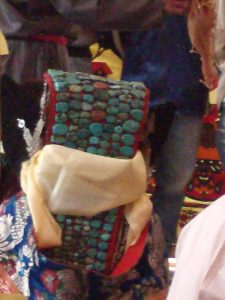
Something else note-worthy: the trip guide and the pilgrimage leader (both males) remarked that Ladakh is a matriarchy, though hidden behind a patriarchal front. For instance, in Tibetan Buddhist religion (the primary religion of Ladakh), the lamas and teachers are primarily males. However, the reason for their saying that the women hold a lot of power is that the females, through their collections of jewelry, possess the wealth in Ladakh. This is definitely noticeable (see the upcoming post about the Ladakhi wedding). Some of the jewelry is very elaborate and the cobra-hoods of turquoise and other precious stones are just incredible – sometimes weighing up to 7 kilograms!

Bride at Ladakhi wedding, ceremonial headress of turquoise

Flying up, over and into Ladakh, India

This material is copyrighted by Kirby Moore.  Reproduction without permission is prohibited.  To support my business and blogging efforts, please visit my website. More recently, I have begun teaching Astrology classes on Trauma-Informed Astrology, see http://www.traumainformedastrology.com for more! Thank you for visiting!

6/18/08 – We woke up at 3 am because we had to catch an early flight to Ladakh.  It turns out, that due to the strong winds off and over the Himalayas, the only window of time to fly into Leh, Ladakh is to leave Delhi between 6 and 7 am.  We were told that the flight into Leh is one of the most spectacular in the world, and IT DID NOT LET US DOWN!  Imagine flying over the some of the highest mountains in the world (which is what we did), with their young, jagged edges reaching for the heavens.  Oh – and Ladakh is north of the Himalayas.  Therefore the plane flew across a vast, snowy landscape of sharp spines and rocky valleys.  (Which I do not have a picture of… hrrumph.)

our guest house kitchen (storage), large pots for a celebration

Some of the tallest peaks poked through the layers of clouds which we were just barely flying above, minimizing our feeling safe at high altitude.  We began to see occasional houses in the high valleys as the plane started its descent.  I saw first hand why the window of time is so slight to fly in – at one point, the plane had to traverse a gap in the rocky spires that was less than 300 (I think?) yards across.  Any “mistake” by the pilots (or more commonly – an unexpected wind shear) and a wing might have clipped an edge.  Whoa!  Talk about splitting the uprights.  (Little did I know, but this “brush with danger” would merely be a slight preview of what was to come on this journey.)  And later I heard that there were apparently only a few dozen pilots in the world that were talented enough to make that flight on a regular basis…  Wow!  No matter how you get to Ladakh – by danger-defying highway or by attempting to fly over the steep cliffs – you are taking a risk.

sand mandala, Saga Dawa, Phyang Gompa June 2008

After arriving, we found out that we had the opportunity to see the Drikung Kyabgon (His Holiness Chetsang Rinpoche, one of the dual heads of the Drikung Kagyu Lineage of Tibetan Buddhism).  He would be departing that afternoon to go into the high country, known as the Chang Tang, where he would be spending the rest of his summer.  The leader of our pilgrimage informed us that attending His Holiness is like being in the presence of a Buddha and a King.  I was excited, understandably.  And thankfully we did not pass up this possibly-once-in-a-lifetime opportunity.

When we landed in Ladakh, I could not help but notice the significant presence of the military.  It makes sense when you think how close Ladakh is to both China (western Tibet) and Pakistan, but there were bunkers all over the airport and military trucks were all around the hangers and terminal.  Actually it turns out that Ladakh (India) uses military personel to run their airport, which I guess saves money.

In Delhi, we were at an altitude of about 500 feet, and suddenly, in the course of a couple hours, we landed at 11,000 plus feet.  Needless to say, I noticed a distinct difference in my breathing.  However, the clear sky, the chilly air and the beautiful mountains surrounding the Upper Indus river valley were crisp, clean and gorgeous.  (pictures)

His Holiness the Drikung Kyabgons' throne, Phyang monastery
His Holiness the Drikung Kyabgons’ throne, Phyang monastery

I immediately noticed a few stray trees, similar to aspens, thin and swaying in the breeze; there were occasional prayer flags, also flapping vigorously.  Inside the airport terminal, I saw something very inspiring – almost every square inch of the support beams and rafters were painted with beautiful scrolling lotuses and intricate flowery designs, in a similar fashion to what we would see over the next few weeks in the monasteries.

We quickly piled in the small SUV’s provided for us and we were driven to the Kidar guest house in Leh.  The Ladakhi guide, Rinchen Namgyal was a precious trip leader.  He was / is kind hearted, sensitive to our needs and able to hook us up with rare opportunities that Westerners might not normally experience (more on this later).  He was also very kind and generous to me when I stayed a week longer than the rest of the “pack.”

Ladakh Pilgrimage, Delhi, June ’08

This material is copyrighted by Kirby Moore.  Reproduction without permission is prohibited.  To support my business and blogging efforts, please visit my website. More recently, I have begun teaching Astrology classes on Trauma-Informed Astrology, see http://www.traumainformedastrology.com for more! Thank you for visiting!

6/17/08 – Having gotten a few hours of sleep (they had to plug in a converter and then play with that to get the A/C going), I explored the World Buddhist Center or WBC.  It was / is a beautiful sanctuary, primarily for Buddhist ordained members and pilgrims.  However, in speaking with people from the Tibetan Buddhist tradition, it seems very challenging to get a reservation (unless you are a nun / monk or an Indian travel agent).  There were many Theravadin Buddhist flavors – the shrines, the images – a strong Thai / Sri Lankan emphasis (in my less-than-skilled opinion).

WBC Large shrine room

The WBC has several floors of dormitories, another with the kitchen and large dining room and the first floor is entirely composed of the main shrine room and a beautifully painted entrance, with a 40 – 50’ ceiling.  However, each floor has a gorgeous and serene shrine, making it easy to fall into a blissful and serene state.  I was fed well, eggs, toast, jam, tea and offered more food than I could eat.

Then I was picked up by Peter again – I wondered how much sleep he got (seriously I worried about the man, he kept talking about doing all these things and forgetting to sleep) – and driven to meet my friends from the states.  I was the first to arrive, hence my staying over at the WBC.  I was driven to the Likir House – a guest house in Delhi named after a monastery in Ladakh.  Several people were there and the pilgrimage leader suggested we rest in the air conditioning for a while and I was very glad for it!

In the afternoon, we went out – to explore Conaught Place and exchange money.  The middle of the day had drivers and tuk tuks buzzing around Delhi, all honking madly and intuitively navigating their vehicles.  Gazing around at the vehicular chaos, I was surprised there were not more accidents.  Somehow order and rule arose in the midst of all the hubbub.

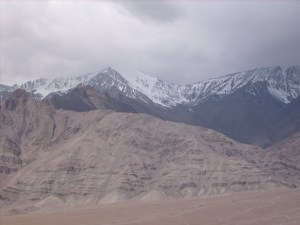
snow capped peaks, view from the guest house, Leh Ladakh
Stok Kangri (21,000 ft) view from the guest house, Leh Ladakh

It turned out several people missed their flight in the U.S., so there were about eight of us going to Ladakh first and then the rest would join us later.  At the Likir house, I did a little practice and it seemed I was “rewarded” by an interesting dream.  Time started doing a strange thing to me – whether it was due to jet lag or what – I felt like I had been in Delhi for weeks, when it was more like 24 hours.  Hmmm.. Buddhist jet lag?

A year in the brewing – Ladakh pilgrimage from Summer ’08

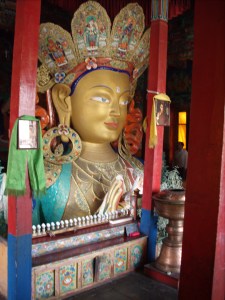
Maitreya Buddha statue from Ladakh, India

This material is copyrighted by Kirby Moore.  Reproduction without permission is prohibited.  To support my business and blogging efforts, please visit my website. More recently, I have begun teaching Astrology classes on Trauma-Informed Astrology, see http://www.traumainformedastrology.com for more! Thank you for visiting!

Pilgrimage to Ladakh, India; June / July 2008

By the way, this title is meant as a double entendre: I have been back from Ladakh for about a year (and been very busy with school) and it took AT LEAST a year to accumulate the merit and other resources required to go on this incredible pilgrimage.

So… as I was mentioning, I finally got the time and space to write this thoughtfully (compared to the bare bones description of my journal).  From 15 June through 15 July ’08 I was on route to / from or in Ladakh India.  Here is entry number one, of many…

6/15/08 – My itinerary for the trip was comical, but considering the tickets were free using mileage plus, I did not complain.  As a result however, I was to fly from Dulles to London to Vienna to Delhi.  Then, on the return trip, I flew from Delhi to Frankfurt to Toronto to Montreal, then took a train from Montreal to New York City and then to Washington D.C. (where I picked up my car and then drove the final 3 hours back home to Charlottesville…  pant pant pant!).

Despite leaving late at 12:30 pm, we were served breakfast on the flight and then a snack, and by the time that was over, we were in London, at 12:45 am – good morning! (again…)  Walked through customs only to discover the lights were out?  And that I could have entered England with anything… hmm?  Maybe everyone who flies in after 1 A.M. is safe…

6/16/08 – Everyone seemed very friendly in the U.K.  Fascinating!  I wonder if that is normal, a fluke, an unusual astrological phenomena or “(E.)” none of the above?  It was interesting – I got turned around in the airport, and spoke with several strangers while I was attempting to sleep and wait.  Everyone was pleasant and amiable.  Great!  On my flight through Vienna, I sat on the plane with an interesting character – Raniger Singh.  He is a humble taxi driver from London, who just happens to speak nine languages – yes, that’s right – nine!  He named off several Indian dialects I had never heard of, plus Hindi, Punjabi, English, German…  Wow!  I felt a little ashamed to merely speak one (what a typical Ammerrican).  Need to work on my Tibetan!

One of the shrines at the World Buddhist Center in Delhi

My luggage did not arrive on my flight, surprise surprise (*see my itinerary).  The gentlemen at Delhi airport handled things professionally however, noting what my baggage looked like and getting my address etc.  I arrived in Delhi at one in the morning, which led to not having to worry about customs twice(!)  [Sometimes, you hear stories of great Lamas or seriously devout practitioners having easy circumstances when they travel (I’m neither of those by the way), but I was glad to not have to deal with a rubber glove on the arrival trip!]  At least in India there were people manning the booths, but I just walked through without stopping.  Whoops!  Of course, they could have stopped me too…

I was met at the airport by a petite Tibetan man named Peter Sonam who has a huge, kind heart (in his little frame).  As his driver took us around the relatively deserted, nocturnal streets of Delhi, he told me about the plans for our trip.  The tiny car we were in almost got swallowed by several enormous potholes – seriously!  From a previous trip to India, I was aware of the wild drivers in Delhi, and even at 1:00 AM, in the course of 20 minutes, the driver honked his horn more than I have in my entire life.  There were a few interesting places in the road where lanes just mysteriously merge and begin again later, without warning.  However, compared to the last time I was here (2001), the experience was very pleasant.

I recall that in my last journey to Delhi, I was shocked and amazed at the enormous number of species / vehicle types sharing the road – cavorting camels, dallying donkeys, consecrated cows, enormous elephants, hungry humans, busy bicycles, roaming rickshaws, tiny tuk tuks – the loud three-wheeled-golf-cart-like, exhaust-spewing vehicles, titanic trucks, bursting-at-the-seams buses, coke-can cars / vans, rare, mercurial Mercedes and pedestrians.  Someone seems to have cleaned up the streets in Delhi – way to go!

The vaulted, beautifully painted entrance to the WBC

Did I mention the heat?!?  OMG!  (Now I know why people with health conditions are warned about summer time in India!)  When I left the confines of the modern, air conditioned airport, stepping out into the noisy lanes of Delhi, I was overwhelmed.  The humidity and heat at 1 AM was enough to make Virginia’s muggy summers pale in comparison!  Think moist sauna – all night and all day – muggy, hot, humid period.

My pleasant ride with Peter Sonam and driver ended as we arrived at the World Buddhist Center, which is a diamond in the rough (see photos!).  The resident monk greeted me and offered tea, as well as generously staying up to chat a little.  I had forgotten it was 2 AM, or rather, my system had no bloody clue what time it was, and I may have kept him up a bit.  But the beautiful and sacred atmosphere of the Buddhist Center there felt like coming home and I was glad.   =^)

P.S. Note to self – next trip, take thrice as many photos – despite taking about 500, I find myself looking for images that I do not have recorded.

Leaving the Zendo, bat medicine and resting down

Where is the Zendo (in spring)?

This material is copyrighted by Kirby Moore.  Reproduction without permission is prohibited.  To support my business and blogging efforts, please visit my website. More recently, I have begun teaching Astrology classes on Trauma-Informed Astrology, see http://www.traumainformedastrology.com for more! Thank you for visiting!

I am sad to say that I am leaving a beautiful community of practitioners and budding friendships.  I will probably continue to sit with them occasionally, but I will be across town, and let me tell you, it is quite a difference – living above a Zendo vs. living a couple miles away.  I worry that the busy-ness of life will catch up with me over the summer.  However, I will make an effort to attend.  (The Sunday sessions are great – tea & zazen & chanting & walking shamatha.)

It has really been a beautiful year.  My past semester went well, despite my abundant amounts of time spent on extracirricular subjects – organizing Buddhist teachings, scrounging for clients and odd jobs, teaching Metta Reiki, etc.  I know I was and am affected by living within such close proximity to the Zen shrine room (I sleep right above it).  There are many, many blessings that I am ever grateful for.

Zendo in Spring, flowering Azaleas, beautiful

There was something else that was most peculiar.  Starting around April 20th, a bat came to the window of my shrine room and would hang out in between the screen and the storm window (outside the actual glass window).  It would sleep and hang upside down – which I guess is normal for bats.  I have never been so close to a wild one in nature, and it was quite a unique experience.  It was fun to be saying prayers for the benefit of all sentient beings and having one be right there! (Note I attempt to live a lifestyle of right livelihood and disciplined ethics, but I have a long way to go!) [Revision on 10/28 – last I heard, the bat was still living in the Zendo window.  Yay!]

The bat came and went, off and mostly on, for about four weeks.  Some of my friends practice shamanism, and they said the bat was there for me.  I believe them.  Of course, that does not tell me why!  But, it was definitely an unusual circumstance – and there are about eight other windows it could have chosen – why the shrine room window?  I wonder if it was also taking refuge, sleeping within sight of numerous Tibetan lamas and Buddhist images.  And yes – you heard correctly – I had my Tibetan Buddhist Shrine set up in the house above the Zendo.  There was a little competition or complementary sharing going on.

Now I am about to move out.  Two doors having been open for a time and they are now closing as I discover new ones.  What significance to you, if any, does a bat indicate?

In my opinion, the bat was indicating that I need to listen better, to take more time resting down – way down, possibly upside down, and that it is time to make and take the appropriate and necessary space to face my shadow.  Perhaps one day, I will be able to “fly around in the dark,” without fear. (What I think I mean, is that one day I will be able to meet perfect strangers, who embody personalities, which in the past might have pushed some of my buttons, with fearlessness and graceful equanimity.)

a bat hung out in the shrine room window for several weeks

By the way, I asked its permission before snapping the photograph.  I believe it was okay to take its picture.

In closing, I am heading out of town for a couple weeks.  If I do not get to post anything before then, thanks for reading, and I will definitely have a lot to share when I return – around June 11th.  Have a great week!

Bodhisattva kitty

This material is copyrighted by Kirby Moore.  Reproduction without permission is prohibited.  To support my business and blogging efforts, please visit my website. More recently, I have begun teaching Astrology classes on Trauma-Informed Astrology, see http://www.traumainformedastrology.com for more! Thank you for visiting!

I just recently returned from a visit to the D.C. area, where I had the good fortune of staying with family, who owned a number of animals (I love animals!).  They had a jack-rat terrier, a little nervous older dog along with a beagle, who of course could never have enough loving, and who learned that sitting up on her hind legs gets her treats, so she is constantly sitting like that when she is not receiving attention.  It is quite comical.  Now on to the cats…

Lewis posing, front view

<As a disclaimer, I am about to project many human emotions / attitudes onto an animal.  He may or may not actually have these traits.>  With that said, the reason I am writing this post, is that they had two cats – an enormous, lean Maine coon, 18 pounds, and in particular, a Manx cat that was a born with a  birth defect – beyond anything normal in their tail-less breed.  The Manx kitty is named Lewis and he is endearingly referred to as “Half-cat.”  I understood why when I saw him sit back.  This cat, already from a species that is without tails, was born missing vertebrae near his lumbar region.  Therefore, he has long hind legs and the ability to sit back on his tail (end), which gives him the impression of coming up out of the floor – almost like a frog and certainly giving rise to the loving nickname of Half-cat.

I say Bodhisattva for several reasons.  One is that this cat is the most gentle feline I have ever come across – when you pick him up and he does not like it, he makes facial expressions of distaste first, and then, if necessary make a slight, soft meow.  He is extremely gentle and if you are petting or brushing him and you stop, he will sit back and then timidly tap you to initiate more attention.  His facial expressions are classic – when tired, it is obvious.  Also, he seems more able to show his vulnerability – something I rarely ever observe in physically-normal kitties.

Lewis posing, side view

There is something else novel about him – he enjoys being on his back and having his stomach and legs rubbed or brushed.  His owner believes that what I am about to explain next is unusual, due to his funny “wiring.”  When the inside of his hind legs are brushed, he goes crazy licking and cleaning his paws – like clockwork – every time!  It was very funny!  Imagine if someone tickled the inside of your leg and you had to rub your ear every time – fascinating.

Last but not least, Lewis’ condition makes it so that his belly and torso in general are very compressed, therefore, he is round and firm.  Also, the vet says that he may not live past five or six due to the compression of his organs.  It is very sad indeed.  I hope I get to see him soon and experience his docile friendliness.  Lewis cat, may you and all beings have a higher, happy rebirth!

Medicine Buddha playfulness

This material is copyrighted by Kirby Moore.  Reproduction without permission is prohibited.  To support my business and blogging efforts, please visit my website. More recently, I have begun teaching Astrology classes on Trauma-Informed Astrology, see http://www.traumainformedastrology.com for more! Thank you for visiting!

I recently attended a Sunday morning Medicine Buddha practice.  I might not be writing about it, except for several surprising instances / experiences.  Khenpo Choepel was the Vajramaster – the person (lama) leading the ceremony.  Typically, the teachers, especially when they are teaching, sit on a raised platform, commonly referred to as a throne – there are multiple reasons for this, some of which go back thousands of years to Buddhism and Tantric practice in ancient India, but I would say that teachers sit in higher positions due to the preciousness of what they are offering.  [Hearing a quality Dharma teaching is a rare, precious opportunity which relatively few get to engage in with ease.  And the teachers do not sit on thrones when they are not teaching Dharma.]

Charlottesville people at the TMC with Khenpo

Anyway, the reason I am writing about this, is that Khenpo Choepel came into the shrine room, where dozens of us were already present for the upcoming ceremony.  However, despite being the Vajramaster, he would not sit on the throne.  This was most unusual to me, until, soon thereafter, who should walk in but Khenchen Rinpoche!  Talk about a surprise and an incredible blessing!?!  Then understanding began to bloom in my mind (very slowly) – as Khenpo and Khenchen commenced to engage in a brief humility contest.  Khenpo would not sit on the throne, and of course, neither would Khenchen (who is technically a higher lama but was not leading the ceremony).  Khenchen then sat down right where he was standing, much to our chagrin – for a high lama to sit on the [dirty] (lower) floor is very disturbing (especially in Asian cultures).  There were several friendly attempts to get him to stand back up, but he would not until a pad and cushion were prepared for him near us, in a lower position than the Vajramaster.  So, I think it was a tie – both Khenpo, sitting on his normal side seat and Khenchen, sitting on a decorative rug proved to be exceptionally humble!

horsing around outside of TMC with Khenpo

A few of us, myself included, very serendipitously, sat close to Khenchen, and his sense of humor and an attitude of appropriate, infinite playfulness definitely shown through.  Amazing!  To shed some light on what I mean, at the end of the ceremony, Tsok food was passed around.  Khenchen did not seem to have a napkin and the large pile came around to me, so of course I offered him one.  He shook his head no.

Thinking he may not have understood what I meant, I tried again, and this time, he said, “No need.”  And then he proceeded to pantomime licking his hands clean!  It was perfectly zapchen and poignantly timed – it directly shattered my “Oh I have to get this right around this high lama” attitude.

Khenchen was serendipitously at the Center because Spring Retreat was starting a week later and he had arrived early.  Wow – I was very pleasantly surprised.  Khenchen is one of my heart teachers – I first took refuge and Bodhisattva vows with him.  MMMMmmmmmm…

Oh – also the TMC was recently painted.  Doesn’t it look great?

[revision 4/4/21 – I believe the first time a Lama is giving an empowerment to the public, he has to have an experienced lama there with him. I’m guessing to supervise the empowerment? Or to provide moral support? Let me know if you have heard of this and care to comment!]