Pilgrimage to Ladakh – Approaching Lama Yuru

This material is copyrighted by Kirby Moore.  Reproduction without permission is prohibited.  To support my business and blogging efforts, please visit my website. More recently, I have begun teaching Astrology classes on Trauma-Informed Astrology, see http://www.traumainformedastrology.com for more! Thank you for visiting!

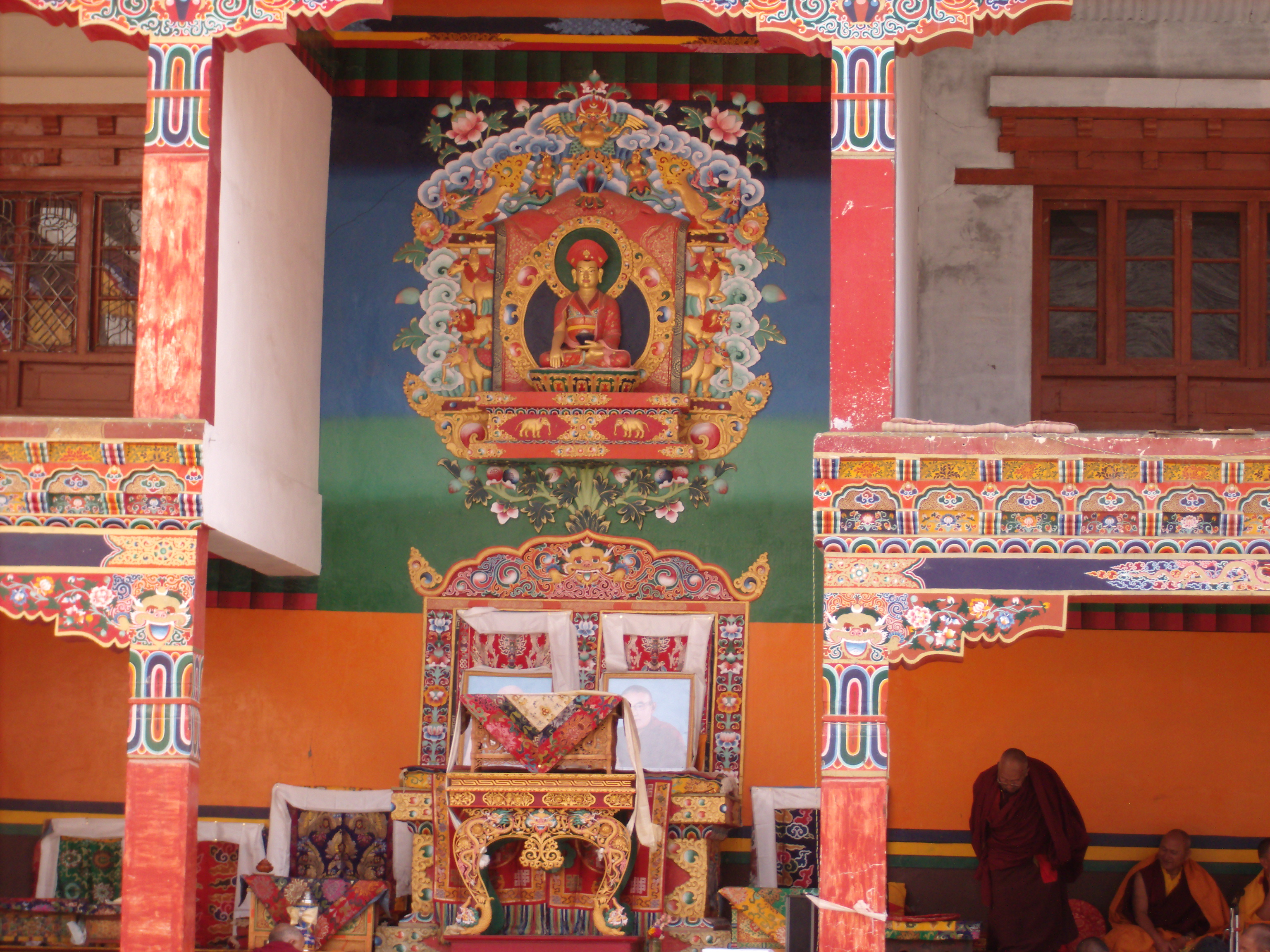
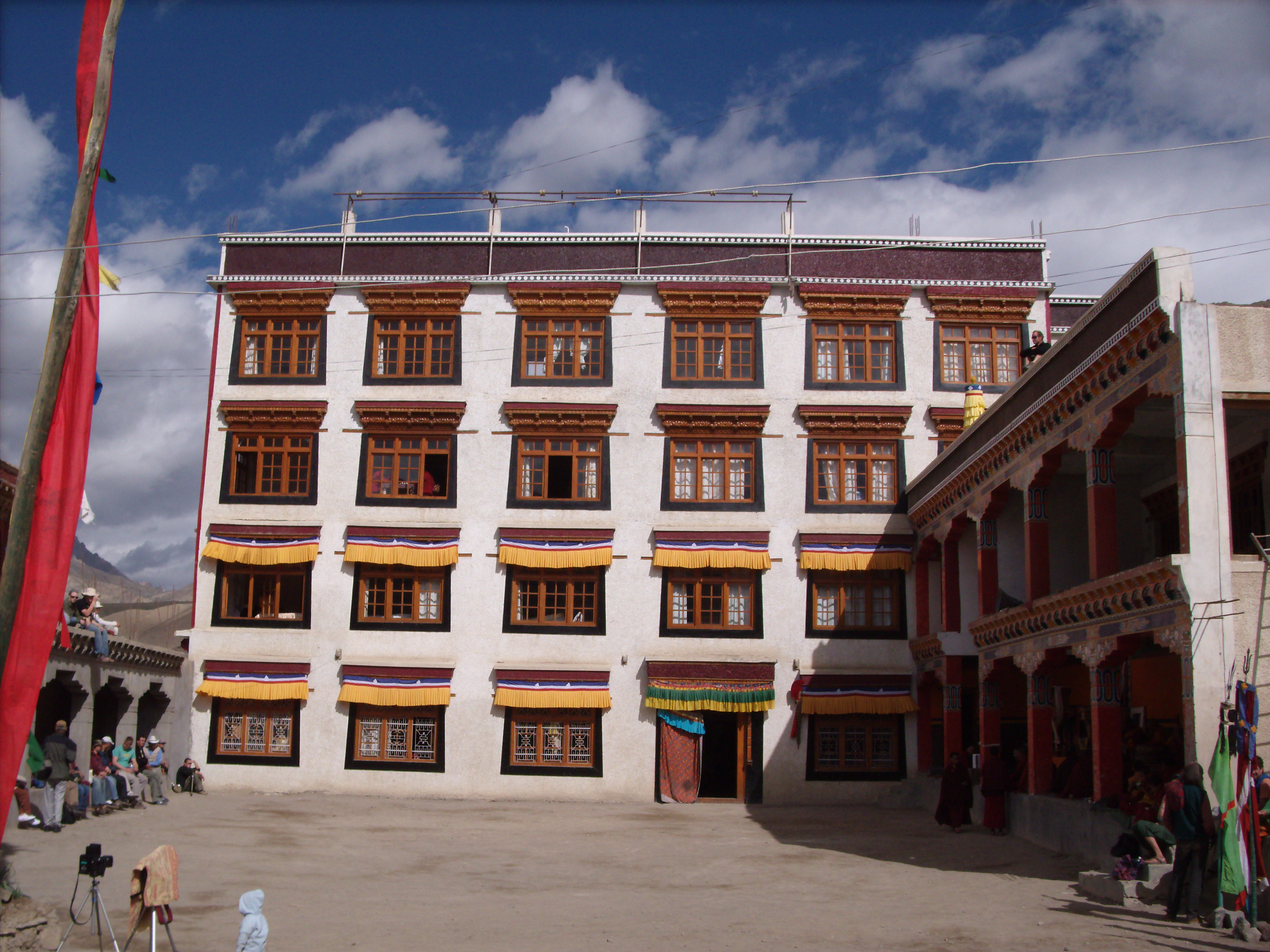
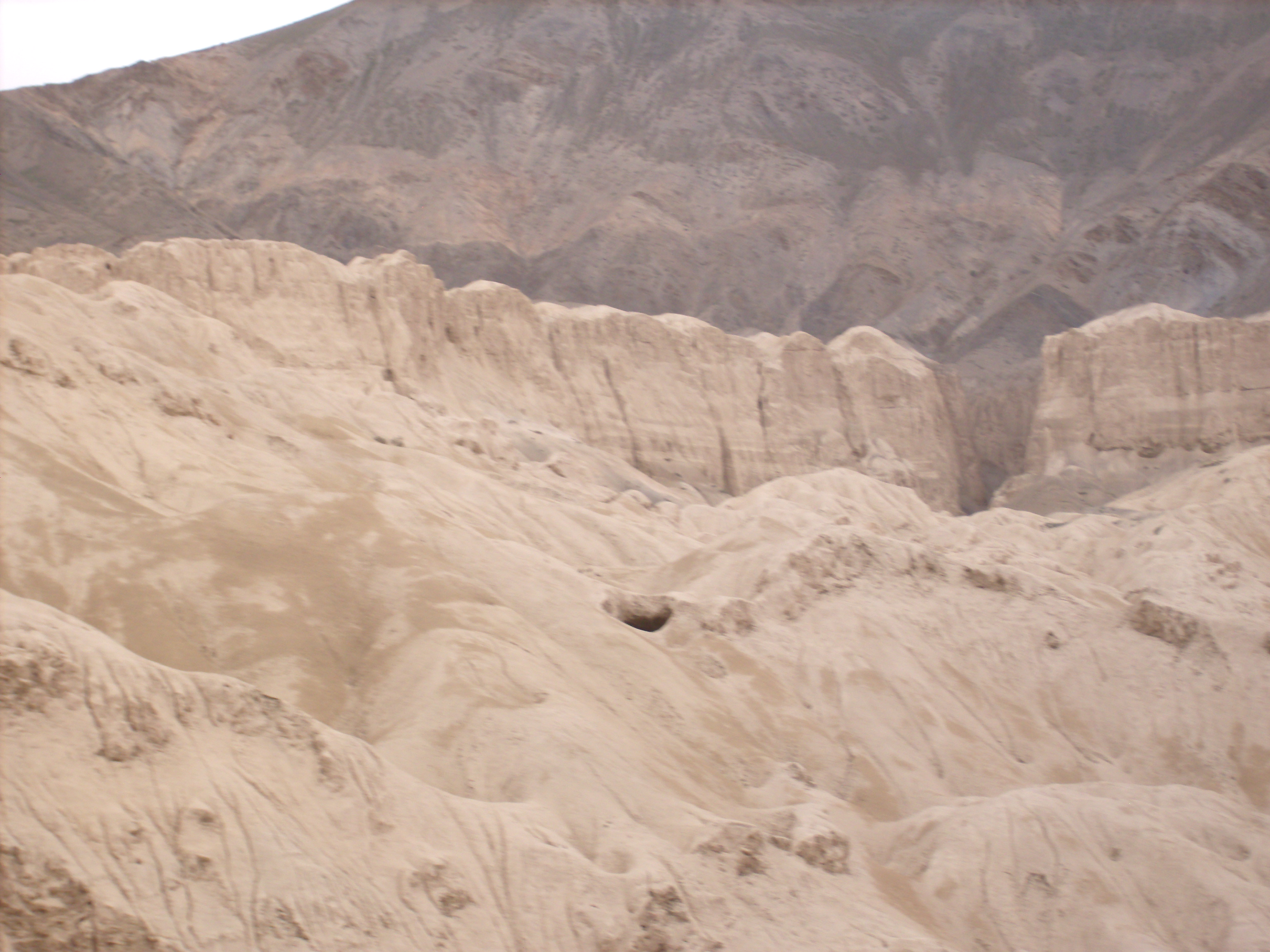
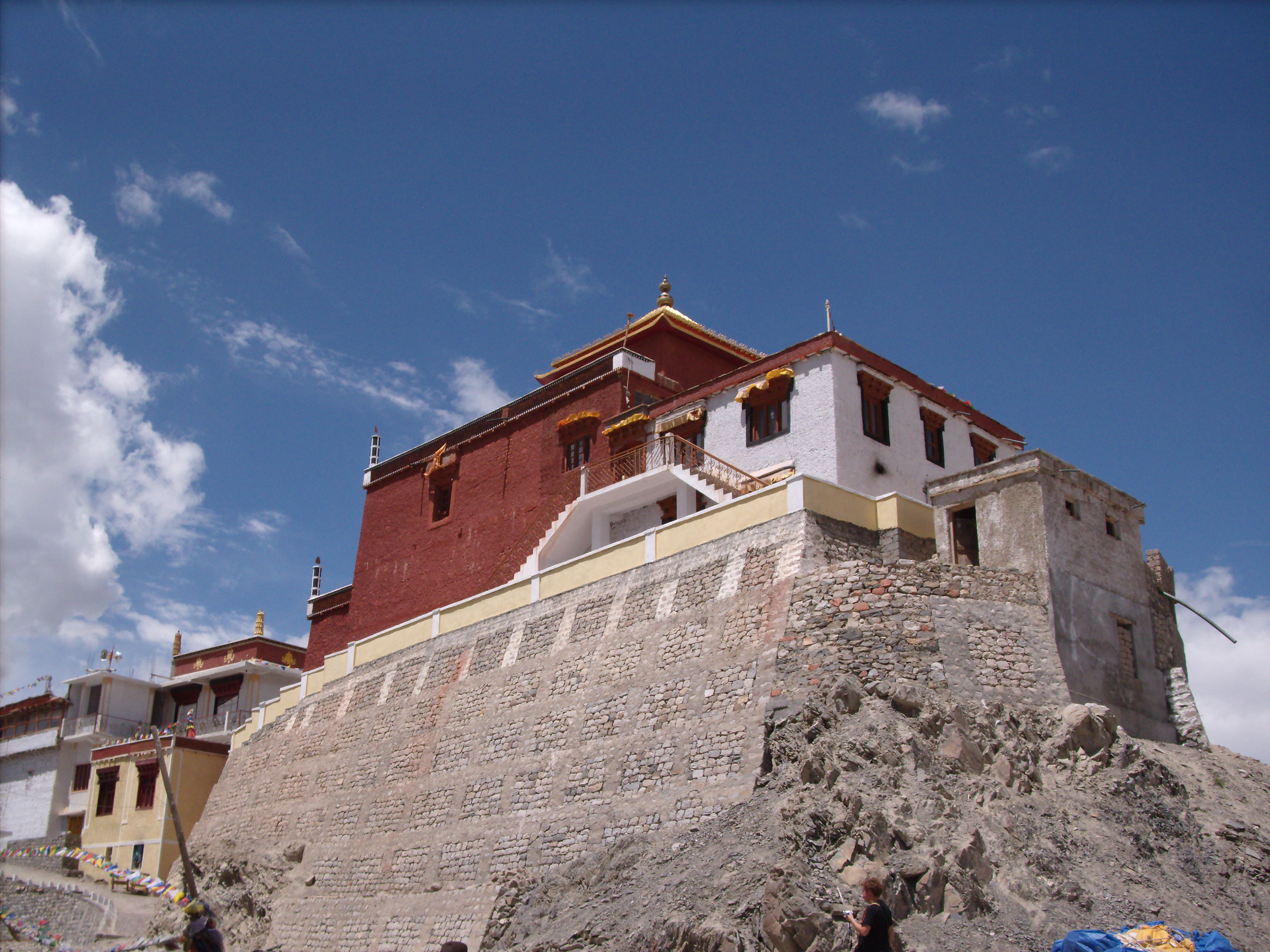
6/29/08 – cont’d – After Tamisgam Monastery we continued on toward the main Drikung Kagyu Monastery in Ladakh (Lama Yuru).  The road to Lama Yuru is twisting, narrow and it hugs the edges of a thin gorge – nothing like the extremely precarious roads we had been on previously, but exciting nonetheless.  On the way, we passed little streams and larger gullies.  There would be irrigation systems traveling above a river, sometimes lasting for several miles before reaching their destinations (they looked like tiny trails above the river, but we were told that they had been or were currently full of water).  As we got closer to the monastery, the terrain changed – noticeably and drastically.  Lama Yuru is high in elevation – at least 14000 ft and it sits on what used to be an ancient lake bed – you can tell because there is a layer of sandy-loamy stone that is level (see photo).  There is a story / myth about this, which I will relate if I find it in my journal.

There was an enormous traffic jam once we got within a mile of the gompa (we could see it above the road).  The road was continuously curving and serpentine, and at one of the curves, an Indian Army 18 wheeled truck had gotten stuck – somehow two of its wheels were off the ground.  Pictures were not really allowed of the military vehicles humorous position.  A tow truck was attempting to right it, but with very little success.  Therefore we were in a pickle, along with about 30 other cars and little vans (full of fellow tourists and locals).

However, luckily we had a crack team of drivers (and four wheel drive Toyotas).  They told us to get out and they were going to try to drive up a steep sandy short cut to get up to the next level of passable road.  Sure enough, despite our group’s skepticism, they made it fine.  We piled in and were on our way.

Our camp was set up when we got there – a bright yellow dining tent, a kitchen tent for the cooks and nine camping tents for us to sleep in.  After choosing our tents and having a snack, Kevin, Bily and I decided it would be smart to climb a nearby hill, to check out a cairn which was on top.  The hike reminded me of being in a cinder cone, like I am used to from hiking in Hawaii – some volcanic, porous stones were around.  It was mostly a dry, sandy soil however.  We watched as a couple of fellow pilgrims attempt to climb up to us via a very steep slope but they failed to make progress and quit (I should have taken that as a sign).

Someone suggested we climb further – Bily noticed a cairn or shrine on top of the mountain which we were under.  It was up there – at least another 500 feet up.  Well, when in Rome…  Or when in Ladakh, follow your crazy fellow pilgrims… right?  Hindsight is always 20 / 20.  We climbed, having to do a circuitous route to avoid some steep slopes.  At some points, we were taking three steps up and then sliding back two as the sand was thick and loose.  Then we had to cross over to a section with a sharp drop to one side. The rocks I was encountering up there were like a form of shale – easily shearing off, so when I went to grab some for leverage, they would break off.  Very shaky!

Note to self – when you are noticing anxiety and fear arising from driving on precarious mountain roads, know that your fear of heights will and does translate to walking / hiking situations as well!  Yeah, long story short, there was one point that was tricky and I had a bad panic attack.  Unfortunately I was wearing my clogs – as in non-lace-up shoes and sand was constantly getting in them and I was worried about them sliding off and losing them down the slope.  After screaming out for help and then praying like I was under extreme duress, I took some deep breaths and squeezed around the tricky boulder.  Both Kevin and Bily were reassuring me that once I did that it was easier and sure enough, it was.  Thank goodness!  My adrenaline was pumping hard and I’m sure I gave them quite a scare as well.  Om Mani Padme Hung Hrih!  They were kind about it however. It was a fairly new experience to be so vulnerable around friends – they were glad to see me emerge from around the boulder.  Yay!

There was an impression or indentation up there, almost like a bath tub, certainly big enough for someone to sleep in.  It was very windy and the prayer flags we visited were flapping in the breezes.  We took a different route down thankfully – needing only to slide long distances down the scree-filled slopes.  Once back at the camp, I resolved to play it safe from then on – I did not need any further scares!

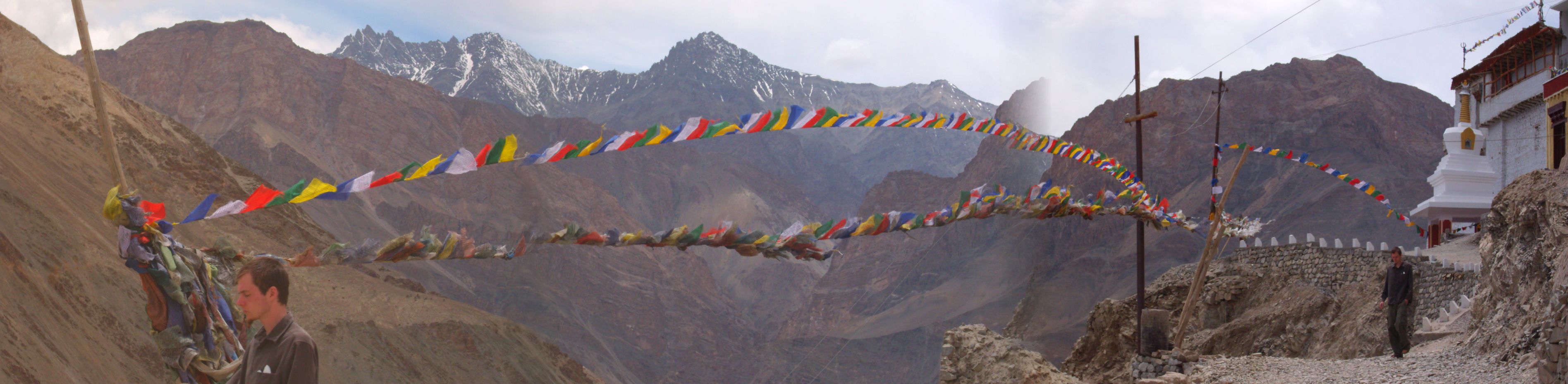
The next time people climbed up that mountain, they brought prayer flags with them and the restrung them.  I opted to stay below and take they picture from camp.  The third photo is of Jeff and Nate, Bily and Kevin hanging a fresh strand of prayer flags.

awarepoetry self care questioned

This is a little existential poetry, hastily written by Kirby Moore on April 20th, 2010.

when meditating, I scan my body, what are the waves I feel?

is it simply awareness perceiving awareness?

sensations move up and down my spine, what is spine?

spine is empty. spine is light. spine is potency. spine is juicy vitality.

when I practice Body Talk on myself, returning to alignment, is emptiness realigning itself?

how can emptiness come out of alignment?

when the bones of skull become tight and Craniosacral adjustment is needed, who is doing the adjusting?

if I notice my digestion acting up (or rather not at all), then time to balance the sphincters (from Visceral Manipulation)

when I reorient the esophageal sphincter, the pyloric, the duodenum junction, etc; are my organs full of emptiness?

are there layers of awareness?  are there layers of emptiness?  where are they?

I perceive various layers in my viscera and internal organs.

Is there an “I” perceiving organs in the first place?  Where is this “I”?

Is all of this merely mind moving through space?

I grin and it is okay.

“And of course, if we are in agreement, then it is time for a nap.” ~quote from Julie Henderson

Pilgrimage to Ladakh – Temisgam Monastery

This material is copyrighted by Kirby Moore.  Reproduction without permission is prohibited.  To support my business and blogging efforts, please visit my website. More recently, I have begun teaching Astrology classes on Trauma-Informed Astrology, see http://www.traumainformedastrology.com for more! Thank you for visiting!

6/29/08 – cont’d – At our little rest on the journey to Lama Yuru, we stayed in the village of Temisgam.  Overlooking this village was a very special monastery (at least to me).  On this pilgrimage, there were several places (monasteries) that felt vaguely familiar – Hemis was a definite, Temisgam was another and Lama Yuru as well – as in not my first time visiting them. In spite of, yes it was my first time visiting this current lifetime.

Back to the story, Temisgam was an unique gompa in that it had a rich history, but it was no longer in use as a (inhabited by multiple monks) monastery.  Rather there was simply one monk running the entire place.  He sat with us when we practiced in the Guru Rinpoche shrine, and then when we were in the large, ornate Lhakang (temple or shrine?), he went back to a little semi-private cell and chanted prayers for a while.  We could peek in at him, but it felt like an invasion of his privacy (so I did not do so).

So, this was an incredibly beautiful and artistic monastery which was obviously well maintained.  From the outside, it looked relatively small – especially for the-only-nearby-town being a small 1300 person village.  The monk said that there are two sects which take care of this particular gompa – the Gelugs and the Drukpa Kagyus and that they take turns – every two years they switch.  The monk said that the monks have a one year rotation of being there (pretty much alone).  There was a Maitreya shrine with a decent sized statue in it (I seem to recall it being at least six feet tall).  The oldest section of the monastery housed an ancient Guru Rinpoche shrine – I think there are some statues in there that are over 600 years old.  That shrine had dozens of ornate statues, ranging from a couple feet to twelve feet in height.  That was where we stopped to do a long group practice – we did the 7 line prayer (Guru Rinpoche’s prayer) along with the full 18 pages of opening prayers.  It was nice, the monk from the monastery joined us and chanted along when we did the Tibetan.

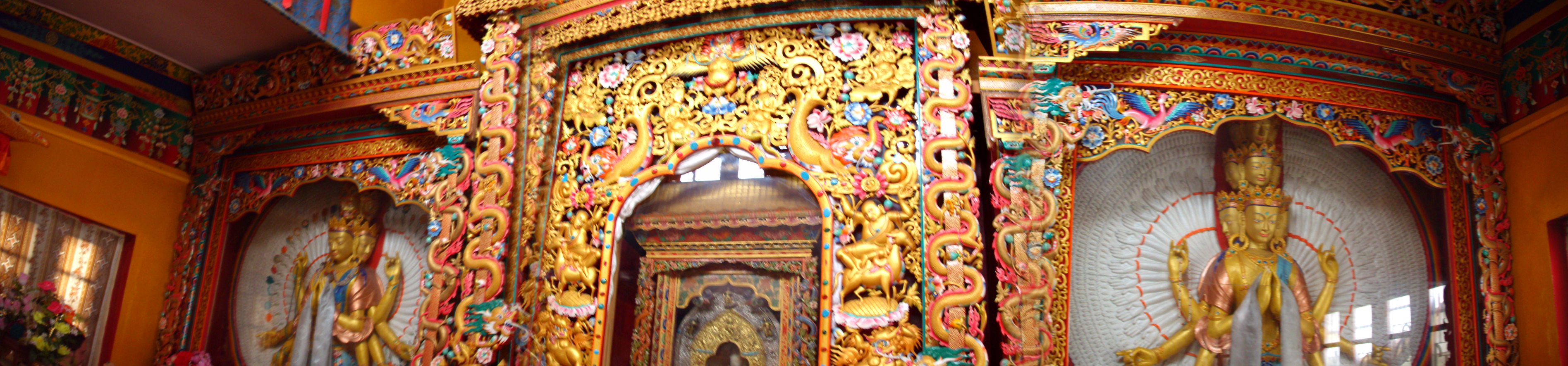
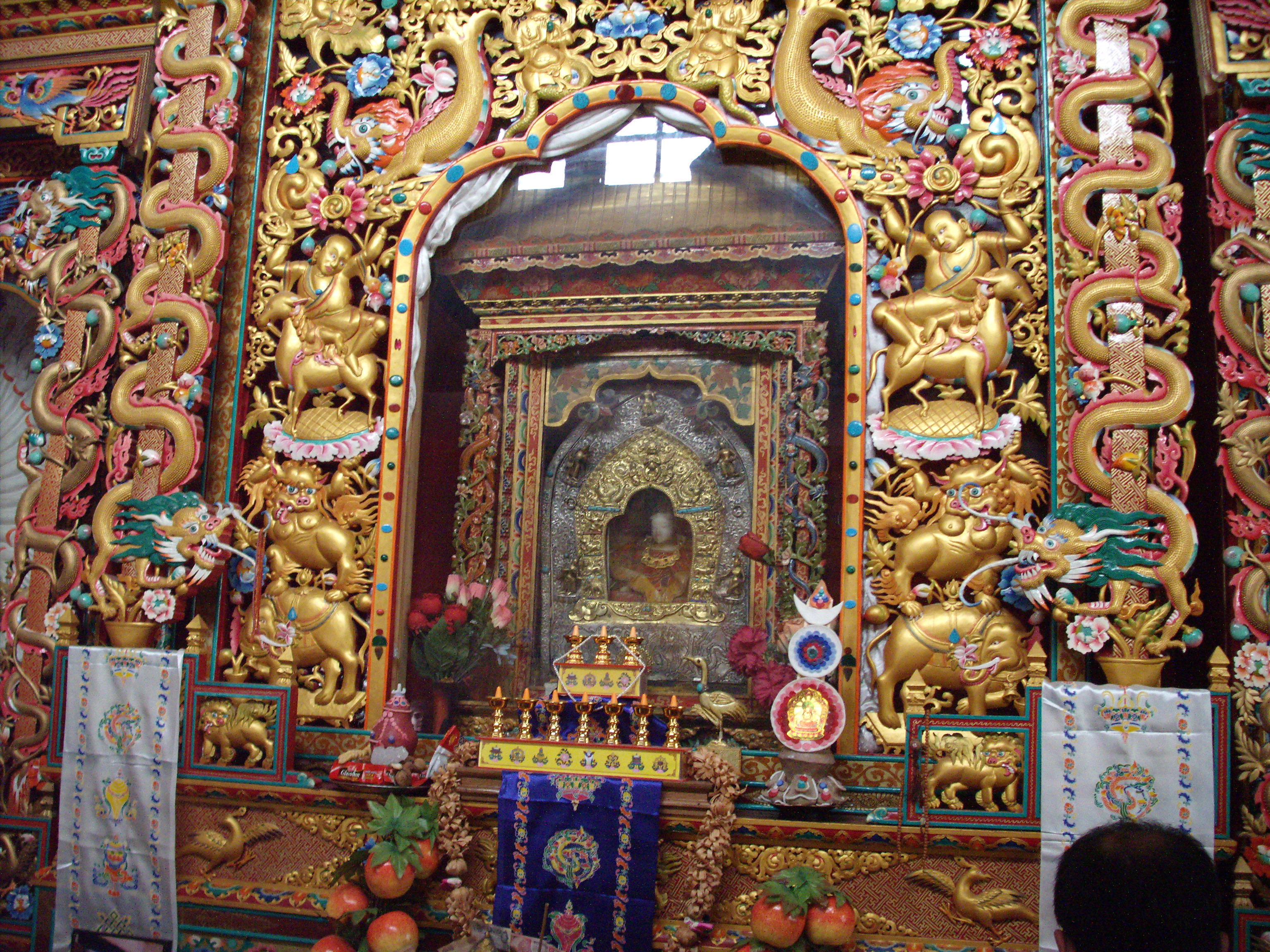
The Chenrezig Shrine (pictured here) was extraordinarily ornate.  There were two large statues behind glass of 1000-arm Chenrezig and then in the center, encased behind several layers of plastic / glass, there was a small little whitish-cream colored statue.  It was only eight inches tall at most – but it was said to have animated / spoken to a high lama when he stayed at the monastery relatively recently.

The monastery was soaked in history.  According to the story I heard, when the Tibetan royalty and their army came in to help the Ladakhis defeat the Baltistan army, this monastery was also a palace.  The Tibetans kept power and increased the wealth of Ladakh as they also built the Shey Palace (which we visited earlier), the Palace at Leh, this one and another where the Zangskar and Indus rivers converge.  These palaces were pretty much built in the 11th century and then rebuilt in the 15th and 18th centuries.  Various ruins are left, but the harsh Ladakhi winter, wind and sun are tough on buildings.

Temisgam had a balcony on the outside of the third floor of the monastery – circumambulating three shrine rooms.  Too bad my fear of heights prevented me from enjoying it fully!  There were wind catchers (spinning turbines) attached to prayer wheels, so the large wheels would sometimes seem to be turning on their own – because they were!  I seem to recall a large Dharma Guardian shrine at this monastery as well – and this building was obviously newer than the first section we visited.

There is a nunnery below the monastery – on the same road.  However, I will write more about that in a future post because we visited it on our way back from Lama Yuru.

In my journal I have the name of this place as both Tamisgam and Temisgam – but now that I look around online, it seems Temisgam is more common.

Pilgrimage to Ladakh – enroute to Lama Yuru (Tamisgam)

This material is copyrighted by Kirby Moore.  Reproduction without permission is prohibited.  To support my business and blogging efforts, please visit my website. More recently, I have begun teaching Astrology classes on Trauma-Informed Astrology, see http://www.traumainformedastrology.com for more! Thank you for visiting!

6/29/08 – What a day!  The guest house we stayed at is nice!  Like wow!  Out in the middle of nowhere, in a small village is this guest house that seems like a Marriot.  There was golden buffet service in the dining room, a reception desk, 16 rooms total, exquisite pictures of Buddhist iconography in the dining room (which is large and spacious).  The village is below a monastery – which we went up to visit.  The village is at least 15 minutes off the main road, in a lush valley.  Its name is Temisgam (along with the monastery).

There is a bird in Ladakh that makes a static noise.  Like scraping paint off an old house with a wire brush.  I have only heard it once so far.  In looking and listening for it in this lush valley, I only hear typical chirrups and peeps.  There are large magpies – a little bigger than East Coast blue jays but much more aggressive if that is possible.  They chase away these large black ravens.  There are also many sparrows, pigeons, bees and butterflies and moths.

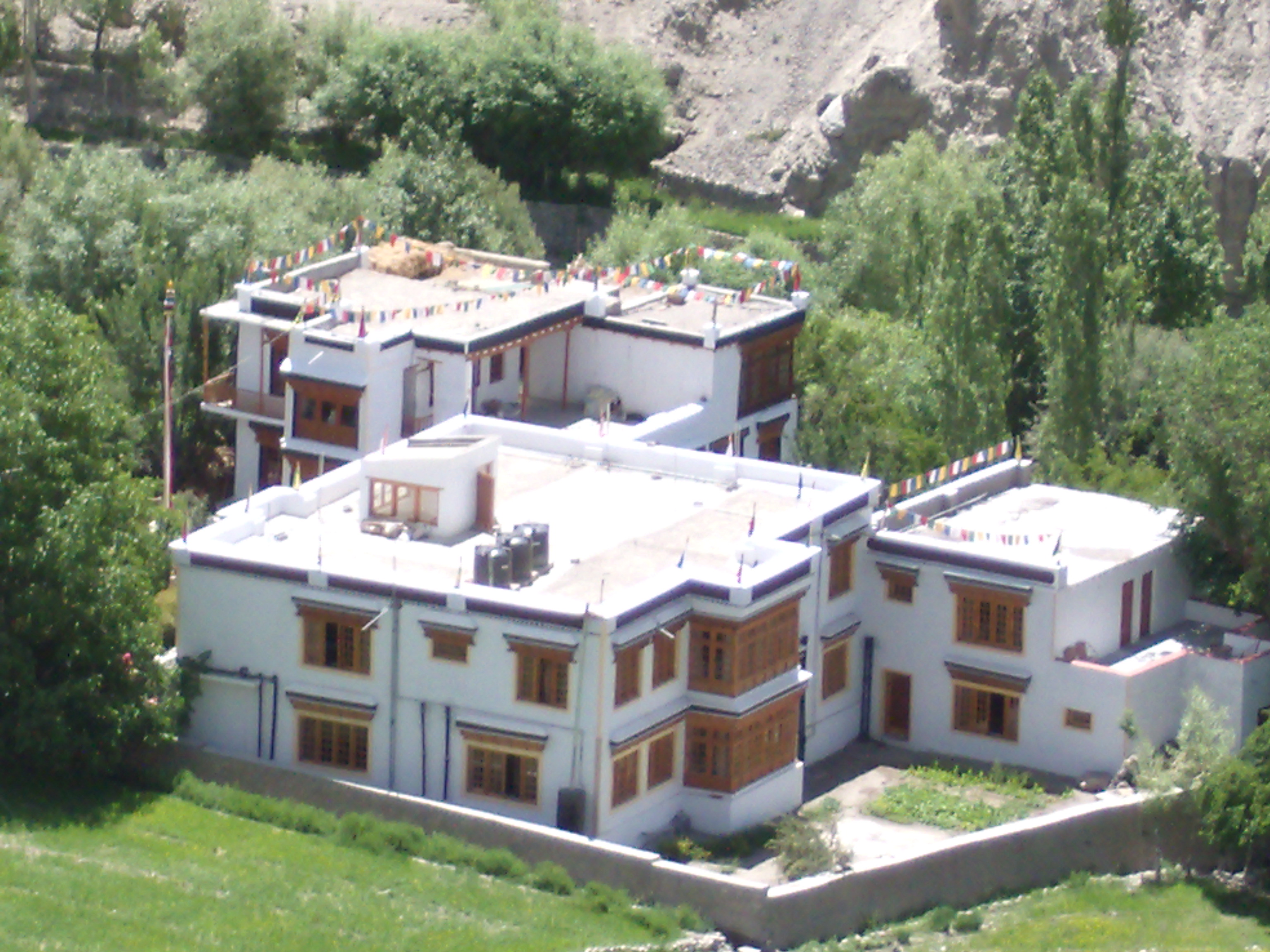
We got to explore the house of the owners of the guest house (next door).  It was interesting – a large house with several bed rooms on two floors.  They had their own cow outside for milking (and yogurt).  Simple bare walls, dirty carpets in a sitting room, dusty dirt floors on the first floor and the walls of the kitchen are covered in soot (they are darker than the other walls of the house).  But then we came to the shrine room – whoa!  It is golden and shiny and sparkly.  Brilliant, clean, colorful rugs, small statues, elevated seating areas, a local lama is sitting in a corner chatting with a couple of family members, and the windows were large and spacious allowing a lot of light into the room.  There were three stupas representing the three lords – Chenrezig (white), Manjushri (yellow) and Vajrapani (blue).  Aside from their shrine room, it was obvious most of the family’s money was tied up in the guest house.

Last night, there was a loud clap – like a thunderbolt.  But there was no storm.  In the morning someone asked what it was and the guide said it was a dragon.  Someone retorts that after seeing the oracle, anything was possible.  Hmmm…

[Revised May 2021: (this is esoteric, bear with me – there are stories of this happening in Tibet) the loud clap may have been the activities of the Dharma protectors clearing away obstacles – or defeating the demons. I don’t know, more speculation.]

The monastery above the village was interesting.  It is basically a museum – there is only one monk there to keep things going.  He said they take shifts taking care of the place – doing practice and prayers, collecting the suggested donations when tourists visit and scheduling maintenance work.  It was a beautiful monastery – too bad it is not still in operation.  We spent quite a bit of time here as it had some of the most precious artwork we had seen yet – especially considering it’s size.  Plus we had a little bit of time to kill as we had ample time to get to Lama Yuru that afternoon.

In my next post, I will detail this fascinating monastery (Tamisgam).

Pilgrimage to Ladakh – Likir and Alchi monasteries

This material is copyrighted by Kirby Moore.  Reproduction without permission is prohibited.  To support my business and blogging efforts, please visit my website. More recently, I have begun teaching Astrology classes on Trauma-Informed Astrology, see http://www.traumainformedastrology.com for more! Thank you for visiting!

6/28/08 – Beware eating raw food in India – even in Ladakh.  As I mentioned previously, I had a bad case of Delhi Belly – I was feverish, nauseous and had digestive issues all night, such that I “slept” on the bathroom floor…  Needless to say, I was a little under the weather for both of these gorgeous monasteries.  However, we started our trip to Lama Yuru monastery on this day, so I guess I “picked” a good day to be ill – most of it was in the car.

Lama Yuru is a solid seven(?) hour plus drive away from Leh, so we visited a couple of monasteries and then planned to stay at a guest house mid way.  The road from Leh to Lama Yuru is a little…  hhmmm… how do I put this?  fragile?  There were some places where either A) sand had blown over the road for at least half a mile, obscuring it completely or B) there was no road and the jeep tracks through the desert were normal…  Yeah.  I was beginning to wonder where we were going – and why there was not a road there.

Anyway, Likir monastery is Gelugpa gompa and it has a huge seated Buddha sitting outside, actually on top of a part of it.  It is a decent size monastery (by Ladakh standards) which also has a school – there are 120 monks in residence at the monastery.  For a good photo of the statue, go here: <http://www.imagesofasia.com/html/indiaphoto/buddha-likir.html&gt;

I was quite ill so I walked around part of the monastery and then went and waited in the car (near the latrine).  I did not go in at all to Alchi Monastery which was next on our list.  But I later read a beautiful (illustrated) book about it in Leh when I was on my own – I visited the local library and found their collection quite nice, if small.  However, Alchi is presently a Gelugpa monastery.  Although there are stories about it being named after the Drikung protector deity / female Buddha Achi – as in Achi Chokyi Drolma.  Sometime in the past few centuries it came under the Yellow Hat influence.  It is known as having some the oldest Buddhist art in Ladakh – no photography is allowed in the main hall.  The influence of Kashmiri and Muslim artists can be seen in its art work.  There are tall statues of Manjushri and I think Avalokitesvara – every square inch of which is painted with intricate, little depictions of the Buddha’s lifestory or the Jataka tales, etc.

I wrote a poem, I think at the guest house at which we stayed.  (A very nice guest house which I will write about in my next post.)

a woman passes beneath my window, singing lilting and joyful words, foreign

a donkey brays, suddenly, piercing the valley’s calm, as if it has been stung, its cry carries on the summer breeze

men sawing away, perpetual construction during the few warm months

an ancient walnut tree, ripe with spherical pods

apricot trees, brimming with green, quarter size fruit


Pilgrimage to Ladakh – a (big hearted) small helper

This material is copyrighted by Kirby Moore.  Reproduction without permission is prohibited.  To support my business and blogging efforts, please visit my website. More recently, I have begun teaching Astrology classes on Trauma-Informed Astrology, see http://www.traumainformedastrology.com for more! Thank you for visiting!

This post is dedicated to Sonam, the nephew of the Guest Housekeepers where we stayed.  He is hardworking, sweet and grounded.  Sometimes I catch him singing to himself, a beautiful and moving Ladakhi tune.  Sonam is fourteen years old, but due to either malnutrition or genetics, he is a short boy.  This does not stop his carrying large pieces of baggage however.  His smile speaks of wisdom long past his years, but it takes a little trust to reveal it.  Some of the members of our group enjoy playing hackey-sack – the game where you stand in a circle and attempt to keep a little beanbag off the ground, without using your hands (feet, head, knees are allowed).  Sonam would join us at this game when he had the chance and he began to bond with several members of the pilgrimage.

Sonam asked me the name of my village and then he asked how much snow my village got.  He is very sweet, if naive, but his English is very good.  Every once in a while, in the midst of his chores, he would timidly come into our room and test out some of his English on whoever was present.  He tried to teach us some Ladakhi – “matahpo means beautiful?”  I wish him well in his Ladakhi life.  Perhaps we will meet again.

When the other members of the pilgrimage headed back, I stuck around for a few days.  I hung out with some Tibetans, visited a couple of sites and did some good reading.  I will post more on this later.  But Sonam was distraught when his new-found friends left and then when I had to say goodbye he was visibly sad.  New friends will arrive, I know it!  By the way, if anyone reads this and goes to stay at the Kidar Guest House, say hello to Sonam for me if you see him.

Pilgrimage to Ladakh – going to see the Amchi (Tibetan Doctor)

This material is copyrighted by Kirby Moore.  Reproduction without permission is prohibited.  To support my business and blogging efforts, please visit my website. More recently, I have begun teaching Astrology classes on Trauma-Informed Astrology, see http://www.traumainformedastrology.com for more! Thank you for visiting!

6/27/08 – cont’d – After the incredible morning visit to the oracle (Ladakhi shaman), we hiked up past Namgyal’s office (he was the main guide and the owner of Yama Trekking Service) to the Tibetan Doctor.  She was a very knowledgeable woman – she gave us a little talk about Tibetan Medicine.  For instance, what does a Tibetan doctor do, how do they diagnose a patient, how do they read the pulses, etc.  Then, we had the opportunity to sign up for sessions with her.  About half of the group signed up to see her, so I decided to wait at a restaurant across the street.

In Tibetan medicine, if I understood it correctly – which is doubtful considering my inferior intellect, there are three main energies or humors – Lung (pronounced “Loong”) or wind, then there are bile and phlegm.  I’m pretty sure however, that the Amchi did not need to read my pulses to know that I had a loong (wind) disorder, which normally has nothing to do with the respiratory lungs.  She asked me some questions before putting her hands on my wrists to read my pulses, about my temperament, sleeping patterns and my health.  Loong disorders are typical in Western cultures – manifestations include anxiety, insomnia, depression and / or extra worry.  She also told me, after reading my pulses, that I also had a lung (respiratory anatomical organ) issue.  Personally, in my private practice and personal study, I believe the lungs have to do with grief and sadness – so maybe I had some grieving to do.

The Amchi told me several things on this particular visit (I would see her a second time as I opted to stay in Ladakh longer).  Things like – “don’t eat raw onions, no grilled foods, no running or strenuous activity for a few weeks, less sugar and do eat heavier foods – like oily sauces and meat.”  This was typical advice for people with loong (wind) disorders.  She also gave me some Tibetan medicine – one little bag of pills to take for a week, and then another to take for two weeks.  By the way, Tibetan medicine pills taste awful!  One might get used to them over time, but wow!  Imagine mixing mud, curry powder and some bitters and then rolling them up in a little ball…  Yick!  On reflection, I am perplexed because I think the first bag was of a purgative nature.  Someone in the group had a little knowledge of Tibetan medicine and he said that the doctors sometimes give you stuff to clean you out – to detox so you can put healthy ingredients back in (? I could be easily misinterpreting that).  I say this because later that night I was very sick – it could have easily been something I ate – but I had a bad case of fever / flu / Delhi belly symptoms.

The second time I visited her, about two weeks later, she read my pulses and said directly, “stop drinking apple juice.”  How did she know?  It was true – I just had some earlier that day, but wow!  Then she mentioned some of what she had said at the earlier visit.  She also gave me a slightly different medicine to take for the next two weeks.

A General Overview of the Healing Process

This material is copyrighted by Kirby Moore.  Reproduction without permission is prohibited.  To support my business and blogging efforts, please visit my website. More recently, I have begun teaching Astrology classes on Trauma-Informed Astrology, see http://www.traumainformedastrology.com for more! Thank you for visiting!

I am writing this post for the benefit of my clients, however, others may find this information useful. Please read the disclaimer at the bottom of the article when you have the chance.*  This is geared toward clients who might be willing to stick with the work over time – I personally recommend doing a series of sessions – whether four, seven or ten or more.  Simply coming in for one session, while potent and beneficial, may not allow for the necessary unwinding and re-organization which the body is requesting.  As a reference to my personal experience, I am including the following paragraph.  If you do not need to read about why I feel I have the experience to write this, then happily skip it.

I have been doing Reiki Energetic Healing, Working with the Craniosacral System and practicing other modalities which I have been certified in, for more than six years.  I also have training and experience in working with Western and Spiritual (Humanistic) Astrology, having done more than 200 charts professionally.  My teachers include qualified, academically trained professors, process-oriented bodyworkers who have connections to Indigenous healing wisdom along with empirically-based graduate degrees, astrologers with more than 20 years of experience under their belts and numerous Tibetan lamas – recognized, realized heart teachers with lifetimes of living the healing wisdom of the Buddha-Dharma.  I have done a few Buddhist retreats, cultivating greater loving-kindness and compassion which is offered in my private practice.  In addition to the above experience and training, I have been on the receiving end of process-oriented bodywork since 2004, having cultivated and maintained quality self care since that time.  And of course, I am just an ordinary human being, doing the best I can with the resources I have available.

I plan to update this material and refine it, but at present, this is a quality, if a little rough-around-the-edges, description of a general trend I have been observing in my clients’ processes (over time).  Quality bodywork of any sort takes time to cultivate true, lasting healing (the trust required to go into the vulnerable, sticky-icky places where we need to do our deepest work takes time).  For most individuals, I believe the body/mind system knows what it needs to heal properly and appropriately – which is one of the reasons I resonate with Biodynamic Craniosacral Therapy.  Biodynamic work is very gentle and patient – when the system is ready to reveal its healing plan, then the practitioner follows it.  Not a moment earlier.  There is nothing for the practitioner to do, nothing to fix and nothing to diagnose (without the client’s system giving its input first, and even then, the practitioner is always listening, going slow and doing less rather than more).  As a result of the body knowing what it needs and when, we cannot push this process.  That would not be kind and I believe it could result in shutting down the budding trust.

The body also knows at what pace to journey down its healing path, to create and nurture lasting healing – not temporary shifts which fall back into old patterns over time.  One of the many respected teachers in the Craniosacral field is Hugh Milne, also an Osteopath, he says in his book, The Heart of Listening, “that we can never go too deep, just too fast.”  I am a follower and proponent of this advice.  As a result, in sessions, no matter what is ailing the client, I work from the feet up – grounding their system and developing the feelings of comfort and trust that are necessary for them to let go of old stuff.

The body generally wants to work on the gross (largest, most pressing) issues first.  Whether structural (from an accident, injury or birth trauma), emotional (e.g. grief, anger, jealousy, etc) or energetic in nature, the body / mind system wants to move toward the fullest expression of its highest potential.  I believe that this desire is true for all of us – to actualize our highest potential and that this is the body’s deepest intention.  If the body needs to let go of something, or shift an old pattern which no longer serves this goal, then it knows what it needs to do.  In the beginning of any session, I ask the client to state an intention for that particular session – which can be anything from, “I want to be more calm and centered,” to “I’m ready to move out of my depression and towards healthy interaction with others” (and anything in between).  [I just want to state for the record that I do not treat depression.  I am using that example as one of the more ambitious intentions that someone could set.]  I believe that energy follows intention and attention.  This is what my teachers have preached; see Julie Henderson’s book on energetic health, The Lover Within. Therefore, the client determines the frame or intention for their particular session.  This is normally in alignment with what the body is looking to accomplish – or to add to this – the body does what it needs to, in order to move toward that intention, along with moving toward its overarching intention of self-actualizing.

Once the grosser issues have been worked through, which could take anywhere from one to twenty sessions – it depends entirely on the client (how much work have they done with other practitioners previously, do they maintain a healthy lifestyle, are they disciplined about doing the homework which healing-facilitators recommend, are they ready to shine some light into the darker recesses of the heart, etc).

Keep in mind that the body will always reveal more healing potentials if we have the capacity.  What this means is that as we make more space and clear the grosser issues, subtler issues can arise which we did not realize were present previously.  This is because our awareness is becoming sharper and more sensitized (healthier), and we are becoming better able to listen to what our body needs.  This is not always the case, but if someone has a history of trauma or abuse (and according to Thomas Merton, a Western monk and mystic, the fast-paced lifestyles that we live here in the West are more than just stressful, but that they are often violent, and certainly not kind – so it might figure that we all have many layers to work through), then it makes sense that we have a number of layers to process.  Until we come into easy, sustainable alignment and equanimity, there will be more to work on.  However, once we start to make some headway on our healing journey, bringing the light of awareness and wholesome persistence, then we start to feel more joy and gratitude with every moment we are blessed with.  As clients (one in particular said this) who have been with me for multiple sessions have said, “Kirby, I would have never known this was possible.  My life is full of sparkly joy now.  Finding the words for it is difficult, but I am happier and more at peace.” I know this sounds a bit corny, but it is what she was feeling, and what I had been noticing as she shifted.

In a future post, I will include an example of what I am referring to in the above paragraph – about the body / mind letting go of old stuff and then discovering new stuff to work on; information on the healing process.  However, I believe that the healing journey can be a lot of work, but it is worth it.  [See foot note below.]  Joy, clarity and lasting lightness of being are possible.  I believe the relationship is reciprocal – we get as much out of the process as we are willing to put into it – in other words, if we are willing to go to some uncomfortable places and do the work, then it will be worth it on the other side.  Sometimes we have to feel it to heal it.  Then we can celebrate our journey.  And with that I bid you a happy Spring!

[Foot note – there are a number of modalities which promise instant results, or immediate healing.  If I hear this, what comes to mind?  Here are my thoughts – do the results, the claimed healing, truly stick?  I believe this is possible but it really depends on the practitioner.  Miracles do happen.  But I would recommend looking at the people who say that they will give you lasting, easy healing, the practitioners themselves – are they balanced?  are they truly, unconditionally happy?  are they living in alignment within their communities and with the Earth?  do they seem to be very wealthy (if they are flaunting it, then this is not a good sign)  There are modalities which claim to go into our belief structures and re-organize them quickly.  Again, I am a little suspicious when I hear this.  What makes process-oriented bodywork so potent, is that through the bodywork aspect (hands on), you can create lasting shifts at the cellular level over time.  But again, the practitioner is not the one doing the work.  The client is the one doing the re-organizing.  The practitioner merely holds space, listens and provides containment for the process.  Rarely and only if appropriate does the practitioner throw in a little coaching.  I’m not trying to knock any type of healing modality, but I have seen people spend a lot of money on modalities which I believe provide very little in the lasting results department.  To wrap this up, have a healthy skepticism toward healing that sounds too good to be true.  Do a little research and analyze the practitioners – are they walking their talk?]

* Disclaimer: I have been trained and certified in working with the Biodynamic Craniosacral system (CST) along with Reiki Energetic Healing, and as a result, I do not treat, cure, prevent or diagnose any disease.  Craniosacral Therapy has had some success with a few, limited bodily issues, but I do not make such a claim. I recently completed undergraduate work with a bachelors of science in psychology.

Pilgrimage to Ladakh – observing an oracle (shaman) in action

This material is copyrighted by Kirby Moore.  Reproduction without permission is prohibited.  To support my business and blogging efforts, please visit my website. More recently, I have begun teaching Astrology classes on Trauma-Informed Astrology, see http://www.traumainformedastrology.com for more! Thank you for visiting!

6/27/08 – Wow!  I continue to gradually move through my journal, from the summer of 2008, and I am pleasantly surprised when I come upon these treasures.  We were very fortunate on this particular journey – seeing several things which only locals would have access to – or that devoted Buddhists might glimpse or request.  This day was one of those special occasions.

We walked all around and through the back alleys of Leh, making some of us wonder if we had gotten lost.  But that was not the case, after crossing numerous little streams (on tiny concrete bridges) and wandering down walled alleys, we made it to the oracle’s house.  We arrived early on purpose.  There were 16 of us plus the guide – so 16 “Injies” or westerners.  The front room, where the oracle and her assistant were busily setting up the shrine (they were not possessed yet), was seriously, 16 ft by 12 ft tops.  We were a little cramped in there ourselves. Just to be clear, this was not a large room!

The oracle and her assistant had a strong, confident glint in their eyes. [See note below.]  They were setting up the small shrine with water bowls, coins, paper money, flowers and tea.  Local Ladakhis started to join us as the time grew near.  Remember, we were already feeling a little crowded…  heh, well that was nothing.  By the time the oracle and her assistant became possessed, there were easily 30 plus people in the room with a dozen more waiting outside.  I was practically sitting on someone’s lap.

The oracle and assistant went outside for some reason, and it turned out, that they become possessed outside and then come in the room.  We could tell something had happened because they came in making many unusual noises – hiccups, guttural growls, whistles and high-pitched moans.  The assistant (apprentice) started hitting herself in the back, a ritual that would repeat later on, shaking and then both apprentice and oracle started chanting / singing.  They sang praises to Guru Rinpoche and to Bakula Rangdrol Nyima Rinpoche (? I have this written in my journal, not sure why.  See previous post regarding this lama.)  The head oracle put two khatas on her head, then a five-pointed crown, a sash and an additional apron.

Then the head oracle turned to us and started answering questions.  We had been prepped ahead of time and we came prepared with one burning question each (some people refrained from asking anything).  Someone said the locals might ask, “where is my yak?”  But we asked questions about our Western lives – relationships, business, emotional process, etc. The oracle would put rice on her drum and then shift it around, doing a divination of sorts and then tell us what she saw / heard.

Because Ladakhi is similar to Tibetan, I could understand a tiny bit of it, and another translator who was on the pilgrimage understood it better.  The oracle answered my question about putting a lot of effort into my business in the fall, ending with, “Bey yak po du!  Bey yak po du.”  Meaning in Tibetan – very, very good / beneficial.  But when our guide was translating what she had said later, he did not say those words at all.  I was curious if there was something lost in the translation (there had after all, been at least half an hour between her answering and his regurgitating those answers).

After all the questions had been asked – by the locals and by us, the oracle then asked if anyone was in need of healing.  This was the bizarre part, as if it could get any stranger!  Someone (a Ladakhi) approached the oracle and pointed to her mouth, saying something (probably about a bad tooth or something).  The oracle then drank some water and then proceeded to suck, using a wide straw-like tool, on the woman’s cheek and then she (the oracle) spit out this gritty, sandy-looking liquid – it was tan in color.  She did this again and then she told the woman that she should see a doctor.

She did this with multiple people.  We witnessed about a half dozen healings and then we got up and left.  The hallway outside was full of shoes – at least 50 pairs were strewn about.  Several people came in to take our spot.  As we walked toward downtown Leh, I had the chance to get my wits about me.  I realized that I had been in a state of shocked amazement / amusement while in there – probably because we were crammed in like sardines and I had never seen an oracle / shaman become possessed.  But we were able to ask questions of our guide and compare notes.  If the healing-by-sucking-on-the-straw-and-then-spitting-out-the-gunk was a fraud, none of us could figure out how she was doing it.  She would take a drink of clear water from a clear glass jar, suck on the straw and then spit out the sandy goop.  Then she repeated this process at least six or seven times without a break.

What was most amazing (to me, as a healing facilitator) is that she only “charged” or asked a donation of 10 rupees for the questions.  That is like 25 cents…  Wow!  Hopefully she charged more for the healings.  Not sure.  Oh – we were not allowed (politely asked not) to take pictures while we were in there, so unfortunately I don’t have any.

[On a side note, if I had not known better, I might compare that look to someone who in our culture might be diagnosed as having a psychological disorder.  But they said that in Ladakh – some psychoses can be used productively.  Silver linings to mental health problems! Very curious indeed.]

Thank you for visiting!

Kirby Moore

konchog chakchen

Pilgrimage to Ladakh – Bakula Rangdrol Nyima Rinpoche

This material is copyrighted by Kirby Moore.  Reproduction without permission is prohibited.  To support my business and blogging efforts, please visit my website. More recently, I have begun teaching Astrology classes on Trauma-Informed Astrology, see http://www.traumainformedastrology.com for more! Thank you for visiting!

6/26/08 – According to my journal, we took it easy today.  That is, after the three day excursion to the Nubra Valley, where there are some of the most precarious roads on the planet.  So I was very happy to do so.  We had some time to explore the shops of Leh and then we reconvened to go visit Bakula Rangdrol Nyima Rinpoche, one of the Tulkus from Lama Yuru Gompa (a Drikung Kagyu monastery).  There is another Bakula Rinpoche (tulku) of the Gelugpa sect, who we also received blessings from; he is a different person.

Bukula Rangdrol Nyima (Rinpoche) had a house on the outskirts of Leh.  It seemed rather ordinary and of a moderate size (nothing too special from the outside).  Inside there were more of the monastic decorations I was expecting – tangkas (religious paintings), banners, the beautiful Buddhist door hangings, and a little shrine or two.  Rinpoche seems to be about my age – early 30’s; he is spry, direct and energetic.  Watching him walk around Lama Yuru later, one could tell he moved with purpose and clarity.  As he is younger, the tutor (or attendant) was there with him – Drupon Sonam Kunga.  Drupon was a short Ladakhi man (monk) who just radiated peace and contentment.  It was very pleasurable and an incredible blessing to meet both of them in such an intimate setting.

They received us and another attendant (a layperson) served us tea and cookies.  Rinpoche spoke a little about Tibetan Buddhism and then answered a few questions.  He also passed out CDs to each of us – he put together a beautiful CD of his singing traditional chants and Buddhist songs.  Very precious.

Later I heard the story that Drupon Sonam Kunga (who did not look old enough for this to be the case, but nonetheless) was in the same 3 year retreat as His Holiness the Drikung Kyabgon (Chetsang Rinpoche).  This was quite a star studded retreat as Khenchen Rinpoche, Konchog Gyaltsen, Drupon Samten and eight other highly respected lamas participated.  It was at this retreat that His Holiness became very ill, so much so that it seemed like he would not be able to finish the prostrations section of the (5-fold path of Mahamudra?) practice.  One of the other lamas found out about His Holiness’ illness and made a petition to the retreat master, who at the time was the highly venerated master Kyunga Rinpoche.  It was noted that Kyunga Rinpoche prostrated to His Holiness and said something like this: “Kyabgon Rinpoche (your Holiness), despite the fact that you are Avalokitesvara (or Manjushri) incarnated, you still must finish your prostrations for the benefit of all sentient beings.”

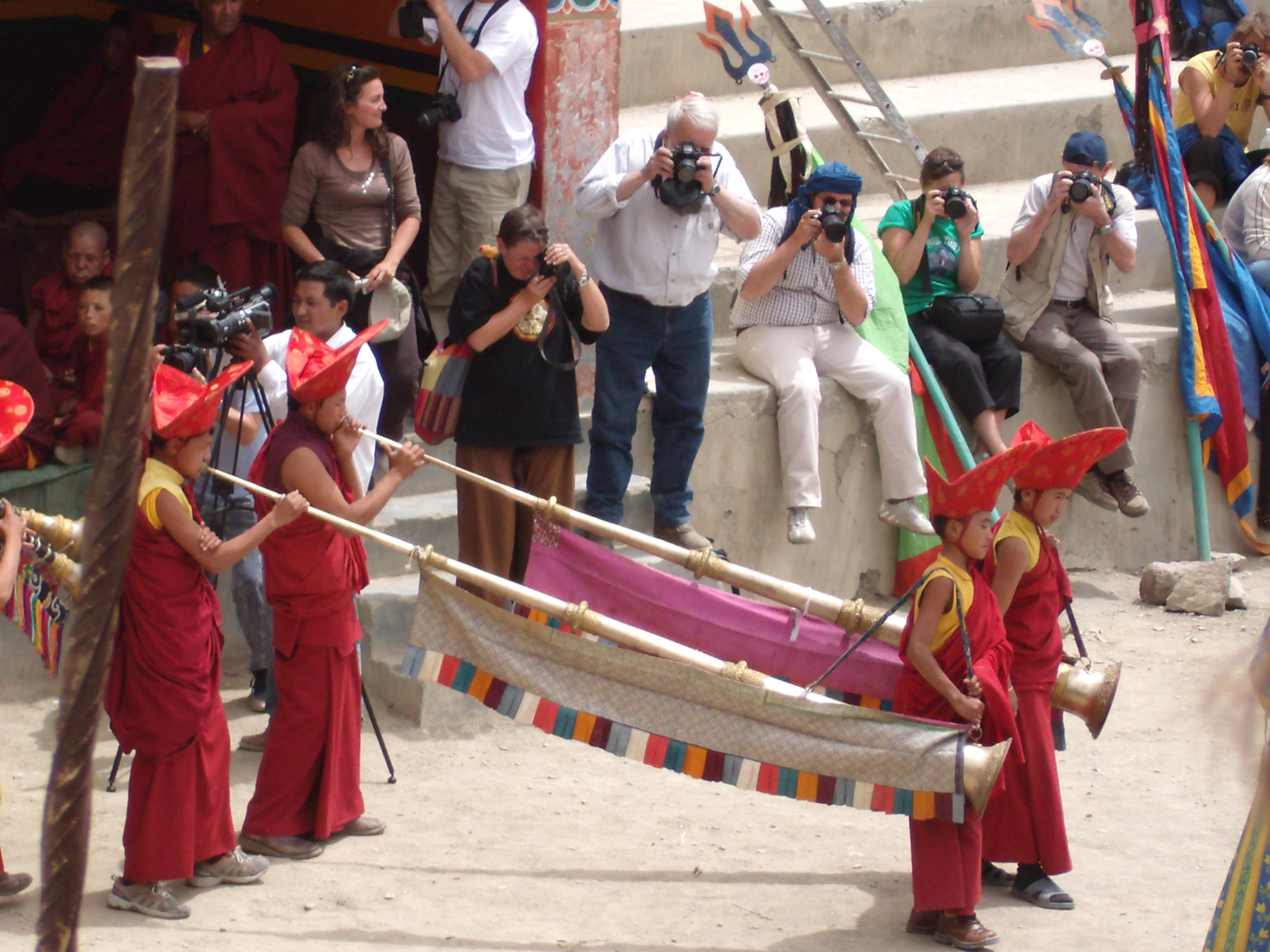
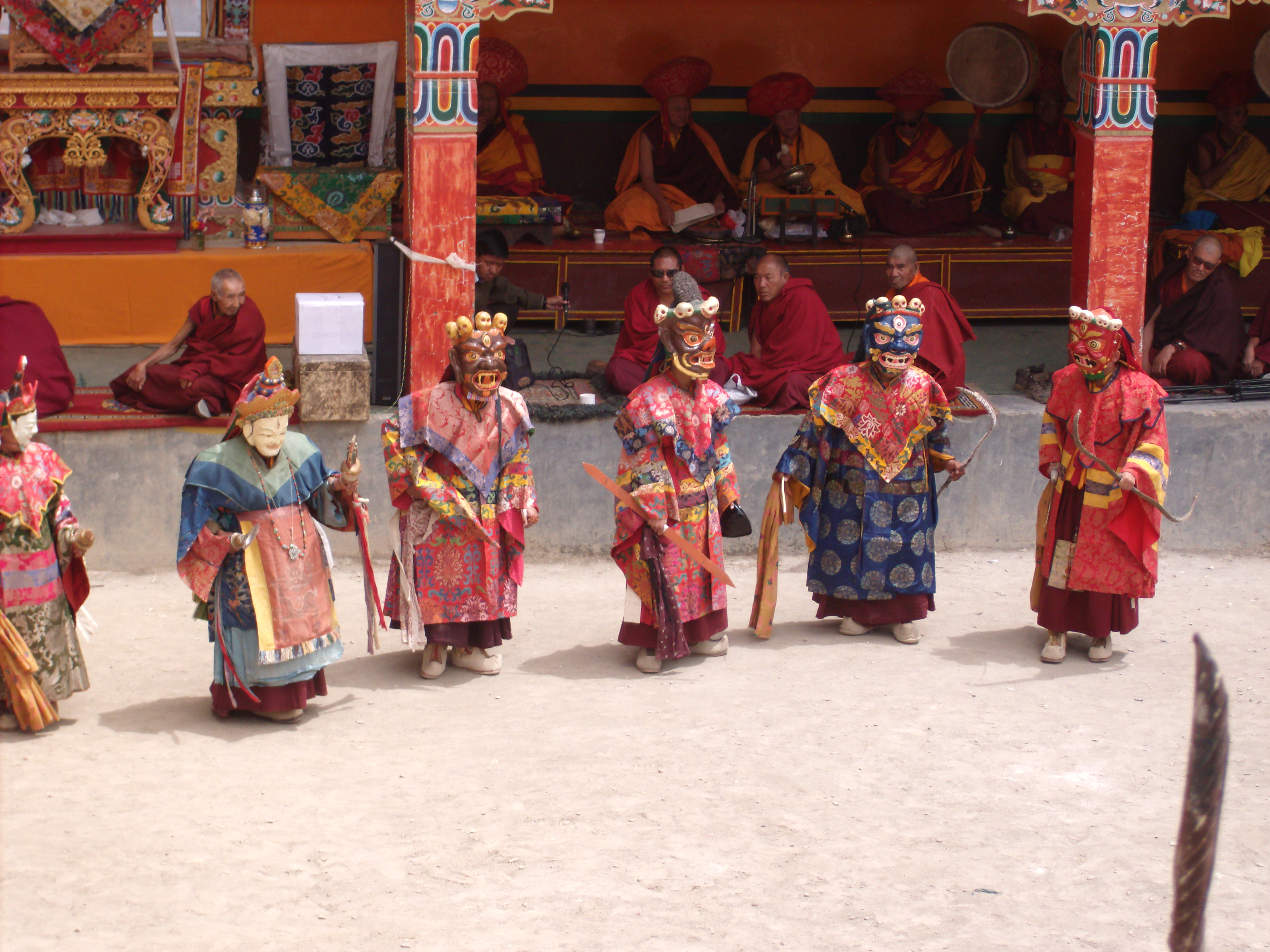
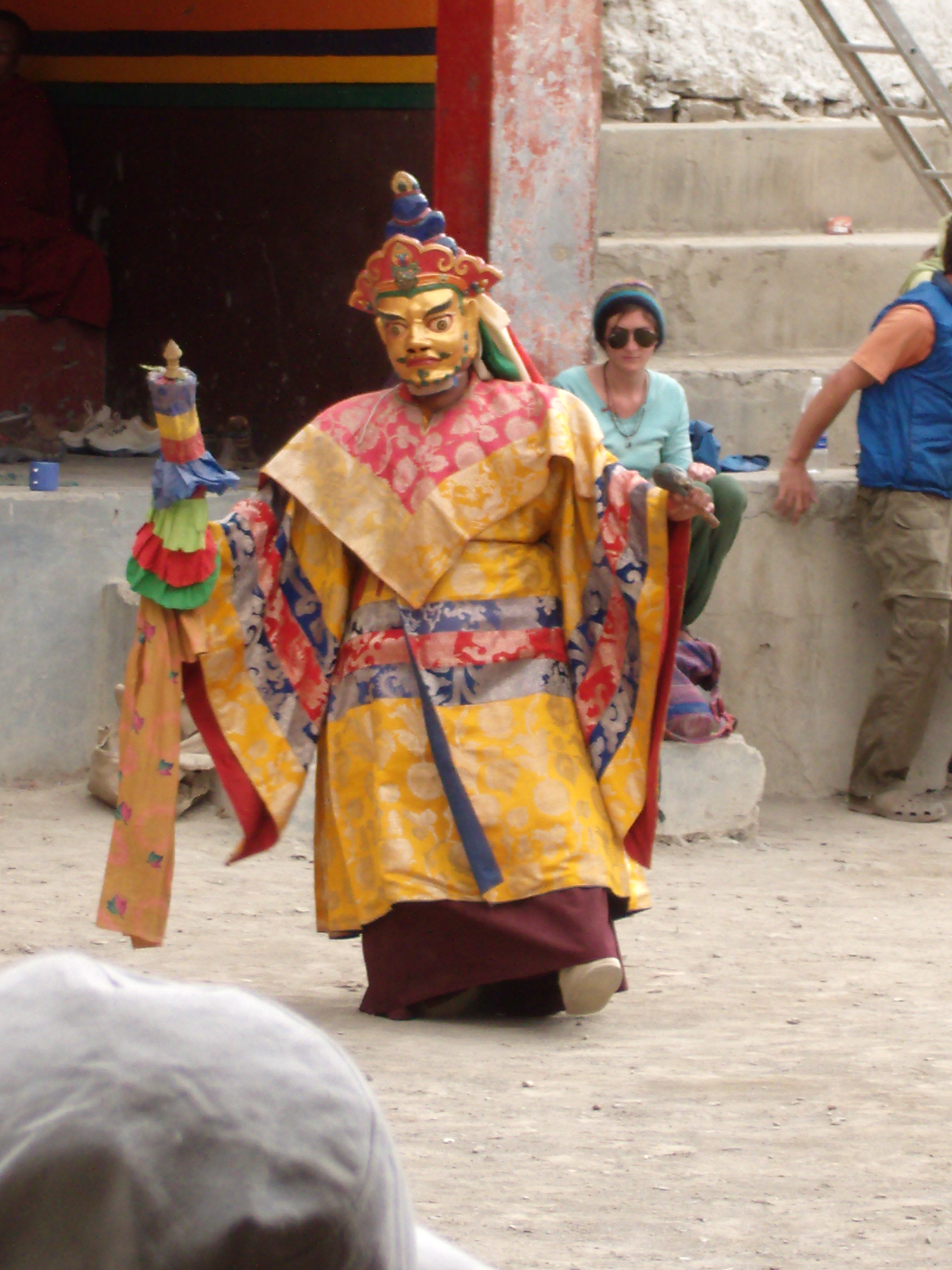
That was inspiring to say the least! Rinpoche (Bakula Rangdrol Nyima) is also known as one of the best Cham dancers (monastic ritual dances) in the Drikung Kagyu.  Later on the Pilgrimage, when we visited Lama Yuru, we had the chance to see him and many others in action.  The photo above is from those dances, I’m not certain it is Rinpoche however.  You can visit <http://www.drikung-kagyu.org&gt; for beautiful photos and for the bio of Rinpoche and many other high lamas.

Bakula Rangdrol Nyima Rinpoche is the 4th reincarnation.  The guide said that while he is alive and residing at Lama Yuru, the main Drikung Kagyu monastery in Ladakh, it flourishes.  However, when he is not around, it declines.  Lama Yuru, he said, supports 400 monks and nuns – some in smaller hermitages, monasteries and solitary retreats.  I think most of them were there for the Cham dances (there were hundreds of ordained running / milling about).  It was quite inspiring and it made me feel good that Tibetan Buddhism still has a lot of support and ordained membership despite what is occurring in China.

Later that day we did a little shopping – where I purchased my first tangka for 3300 rupees (~$80 US) – what a deal.  It is a beautiful tangka of Green Tara.

Thank you for visiting!

Kirby Moore

konchog chakchen